



In this guide
- Choose the frequency and read the session definition
- Acknowledgement is an interruption, not a spending decision
- Look at history as well as time
- Multiple games can complicate a timer
- When a reminder is not enough
- Keep the guide’s limits clear
- A session duration is different from a clock reading
- Reminder frequency is not a session allowance
- Read the setting without inventing a screen sequence
- Acknowledging a panel does not answer whether to continue
- Use a money record to answer a money question
- Two timers can have two valid start points
- Background tabs and interruptions need a defined rule
- Midnight does not define every session
- A frequency change needs its own confirmation
- A missing or unreadable prompt is a support question
- Combine tools by their function
- Keep a reminder question free of private credentials
- These reading dialogs are not casino reality checks
- Stopping does not require finishing the analysis
Choose the frequency and read the session definition
RTS 13B requires accessible facilities for selecting the frequency of reality checks during a gaming session. The reminder concerns time elapsed since the session began. It is not simply the time of day on the device clock.
The standard permits different implementations, including account-level, product-level and hybrid arrangements. A reminder on one game may therefore refer to a different period from another product’s timer. The operator should explain how its arrangement works.
Acknowledgement is an interruption, not a spending decision
The customer must acknowledge the reminder to remove it. The standard also addresses preventing commitment to a new game before acknowledgement, with a specific distinction for an already running multi-state game.
That pause should be used to review whether to stop. Acknowledging the panel does not establish affordability, reset earlier losses or make continued play safer. Do not treat dismissing a reminder as a required next step.
Look at history as well as time
The standard says the reality check should provide a route to account history and a way to exit the session or log out, according to the implementation. Time alone cannot show the financial effect of the session.
Use the history’s actual stake and return entries rather than estimating spending from the number of animations. A series of refills can occur within one slot cycle, while multiple separate bets can accumulate within a short period.
| Information or tool | What it answers |
|---|---|
| Elapsed-time display | How long the defined session has run |
| Reality-check frequency | When another reminder appears |
| Account history | Which money and gambling entries were recorded |
| Deposit cap | How new funding is limited |
| Time-out | Whether gambling access is paused |

Multiple games can complicate a timer
An account-level reminder may span product changes, while a product-level reminder may track individual sessions separately. The technical guidance discusses these alternatives rather than prescribing one identical screen for every operator.
If the figures look inconsistent, first read which session each panel measures. A different start point can explain a difference without proving that either number is a total of every minute spent on the account.
When a reminder is not enough
If repeated prompts are being dismissed while spending or time becomes uncomfortable, consider a time-out or self-exclusion rather than adjusting the reminder to appear less often. A bank gambling block can address the payment layer separately.
You do not need to finish a game session to seek support. Use an established support route and keep any protective controls active. The purpose is to reduce further exposure, not to find a setting that permits a longer session.
Keep the guide’s limits clear
The diagram on this page explains the distinction between a timer, an acknowledgement and a break. It is not a screenshot of an operator’s reminder or evidence that a specific account was tested.
This page concerns the GB technical standard for gaming sessions. It does not guarantee a reminder’s exact appearance, provide an account-control service or calculate a safe period for an individual to gamble.
A session duration is different from a clock reading
A clock reading tells you the time of day. An elapsed-time figure measures the interval from a defined starting point. For a hypothetical example, a session beginning at 19:10 and reviewed at 19:40 has run for thirty minutes if the implementation counts that whole interval. The clock reading 19:40 and the duration thirty minutes answer different questions. Neither tells you how much money changed hands.
Start by checking when the timer begins. The provider may count at account level, product level or through a combination of both. Opening a new game does not necessarily restart every relevant timer, and the figure on a single panel may not cover all account activity. Read the operator's explanation before trying to piece the rules together from the numbers on screen.
A clear personal note can preserve the wording of the timer and the product involved without recording a whole account history. If the operator explanation leaves the starting point unclear, ask that narrow question. You do not need another gambling session to discover whether your interpretation was right. The useful outcome is understanding the measure, not producing a new sequence of bets to test it.
Reminder frequency is not a session allowance
The frequency setting controls the spacing of reminders. It does not tell you how much gambling time is suitable for you. If a hypothetical interface offers several intervals, choosing one changes when its prompts appear under that interface's rules. Reaching the next prompt still says nothing about whether continued play is affordable or harmless. You can stop before a reminder appears; the interval is no reason to wait.
It is helpful to distinguish an interval from total elapsed time. A panel appearing every fifteen minutes could report a longer duration at a later appearance. The later figure need not have reset to fifteen minutes, because the reminder can describe time since the session began rather than time since the last acknowledgement. This is an illustrative distinction, not a claim about a particular operator screen.
If the intention is to stop at a particular point, read the time-out or self-exclusion guide rather than treating another reminder as an access restriction. A reminder can be dismissed; its informational role is different from a barrier intended to prevent gambling. No interval on this page is offered as a personal safe-session limit or a substitute for deciding to stop now.
Read the setting without inventing a screen sequence
There is no single button sequence for every operator. The standard describes the facility, and each operator presents its controls within that framework. Look in the genuine account's responsible-gambling or session-control information, then read the description beside the frequency setting. An icon may look familiar while referring to a different tool, so check whether it controls reminders, a session clock or something else.
Check what the confirmation actually says. It may identify the chosen interval and the scope of the setting. If it does not explain when a change takes effect or which products it covers, ask the operator for that information. Do not turn a missing explanation into an assumption that the most favourable interpretation applies across every open product.
Keep the task narrow. Understanding the setting does not require placing a bet, increasing a balance or opening another account. An operator can explain its own documentation through the genuine support route. The publication cannot see or change the setting, and an illustrative diagram here should not be treated as the precise layout of the control on a reader’s account.
Acknowledging a panel does not answer whether to continue
Closing the panel records an acknowledgement, not a review of someone's finances or personal circumstances. You can leave the session instead of pressing the dismiss button and carrying on. The pause gives you a chance to reconsider or stop; it is not a task you need to complete before gambling again. A successful click cannot establish whether continuing is a good decision for you.
The distinction matters when a prompt becomes familiar. Repeatedly closing the same panel can become a routine action that supplies little reflection. If the reminder is no longer helping with the intended purpose, making it less frequent does not address a need to stop access. A time-out or exclusion addresses a different layer and can be considered without first proving that a reminder failed.
The technical treatment of an already running multi-state game should also not become an invitation to commit more money. The standard’s implementation detail concerns how the interruption operates. It does not create a personal obligation to continue a session or recover earlier stakes. If the rules or remaining state are unclear, use the genuine operator explanation and keep the choice to stop separate from the mechanics.
Use a money record to answer a money question
A timer cannot show the financial effect of a session. A hypothetical thirty-minute period could contain one completed wager, many wagers or no wagers during part of the interval. The duration alone does not identify stakes, returns, deposits or withdrawals. To understand money, use the relevant account-history entries and the definitions attached to the operator’s figures.
For illustration, suppose a cash-only account begins with twenty pounds, receives one completed five-pound deposit and has no other movement at that point. The balance would be twenty-five pounds under those assumptions. A reality-check panel appearing at the same moment would not establish that result. Its time figure and the ledger calculation describe different dimensions of the account.
Use references and timestamps to tell repeated amounts apart. Neither the number of animations nor your impression of the session's length gives a reliable money total. A feature can pass through several visual stages without creating a new funding movement at each stage. For the financial question, follow the transaction-history guide and the recorded entries; use the reminder to understand elapsed time.
Two timers can have two valid start points
Imagine an account-level session that began before a second product was opened. A product-level timer on the newer product could display less time than an account-level reminder. That hypothetical difference does not by itself establish that either timer is broken. It first raises a scope question: which interval is each display intended to measure?
Check the operator's explanation before treating any timer as the account's complete time total. A hybrid arrangement can be particularly confusing when several time labels appear on the same page. Keep the label and a note of where it appeared if you need clarification. Copying the number alone makes it harder to explain which period or product you were looking at.
Do not open additional games to map the timer behaviour. That would create more activity while leaving the documentation question unresolved. Ask the genuine operator which setting applies across products and which session the reminder reports. If the need is a break from gambling, use the relevant access-control route instead of spending more time trying to make every timer agree.
Background tabs and interruptions need a defined rule
A device can be locked, a tab can move into the background and a connection can be interrupted. Those events do not tell this publication how a particular operator defines its session boundary. The timer may have an implementation-specific treatment that needs to be read in the operator’s information. Do not assume that a hidden tab automatically stops every clock or that reconnecting always creates a new session.
After an interruption, a surprising duration is a reason to ask a specific question. Did the session keep running? Was the reminder delayed? Did a product retain its earlier start time? Each question concerns the timer's behaviour. Whether a wager was accepted or settled is a separate matter for the transaction record, which the elapsed-time display cannot answer on its own.
An operator can explain its own implementation without requiring you to repeat the interruption during gambling. Keep the observed label, approximate time and product name if needed, while leaving private credentials out of the report. If the explanation remains unclear, avoid building a personal stopping plan around an assumption about background behaviour. A dedicated access restriction is a different tool from a timer.
Midnight does not define every session
A session duration and a calendar-day total need not use the same boundary. A hypothetical session beginning before midnight and continuing afterwards crosses a date change while still spanning one elapsed interval under the example’s assumptions. The next date on the device clock does not prove that a reminder’s session has restarted. The actual implementation must determine the relevant meaning.
This distinction also helps avoid confusing a time reminder with a daily deposit cap. A funding limit has its own calculation period and rules. A timer changing its display does not replenish a deposit allowance, and a funding period changing does not establish that the session timer has reset. Read each control through its own definition rather than treating a shared word such as daily as a common mechanism.
If the operator uses a stated time zone or period boundary, retain that wording when asking for clarification. This guide does not invent a universal midnight rule or a processing calendar for every account. The purpose is to recognise when two figures concern different periods, so that a question can be directed to the right setting without another gambling transaction.
A frequency change needs its own confirmation
Changing a reminder interval can raise questions about when the new choice takes effect and whether it applies to an existing session. This publication does not assume one answer for every implementation. Read the setting’s explanation and any confirmation rather than inferring the result from the next panel alone. A delayed appearance can have several possible causes that the public diagram cannot diagnose.
The useful record is the chosen setting and the operator’s stated effect. If the wording is unclear, ask whether the change concerns the current session, future sessions or a particular product. Do not treat the absence of an immediate reminder as proof that the setting was accepted or rejected. The operator’s actual record and implementation information are the relevant evidence.
If you want to change the interval because the reminders feel uncomfortable, pause to consider what you need. Fewer interruptions and a break from gambling are different outcomes. Spacing the prompts further apart may do the former while leaving access open. You can use a break or seek support now, without first finding a reminder frequency that feels right or trying every available interval.
A missing or unreadable prompt is a support question
If a reminder is hard to read, hidden or inconsistent with the documented setting, report what you can actually observe through the operator's genuine support route. Name the product and setting, and include the relevant visible wording. Explain which information or choice you could not understand. That gives support a clearer starting point than a technical diagnosis based on a screenshot alone.
Accessibility matters because an interruption is useful only if its information and choices can be understood. The publication cannot inspect a reader’s browser, assistive technology or account implementation. It therefore does not promise a universal keyboard sequence or a specific display fix. The operator should explain the facility it provides and the relevant help available for that interface.
Do not continue gambling to collect more examples of a suspected problem. Keep the necessary observation privately and ask for clarification. If the intended result is to stop while the issue is considered, use an appropriate access-control route. A difficulty reading a reminder should not be treated as a reason to dispense with a protective intention or extend the session.
Combine tools by their function
A reminder, funding cap and bank block can sit at different layers. The reminder supplies session information. A deposit cap concerns incoming funding under its stated calculation. A bank block concerns payment coverage defined by the bank. A time-out or exclusion concerns gambling access within its scope. None automatically proves that another layer has been addressed.
This is why a reminder should not be described as a spending barrier. An account may already hold money even when new deposits are restricted. Equally, a payment control may not explain whether an operator session remains accessible. Read the actual scope of each tool and ask the relevant provider about unresolved coverage. The point is to understand the barrier, not to search for a route around it.
You can go straight to the support and exclusion pages if stopping is difficult. There is no need to work through every reminder setting before considering stronger help. This publication explains how the tools differ; it does not score combinations or promise that combining them makes gambling safe. Use the descriptions to check whether a tool serves the protection you actually want.
Keep a reminder question free of private credentials
A question about a timer rarely needs a full account screenshot. The label, product, selected interval and approximate observed duration can often describe the issue. If a genuine provider requests further evidence through its secure process, follow that process and consider which fields are relevant. Do not publish balances, account identifiers or message histories merely to demonstrate that a panel appeared.
This publication has no document intake or access to the setting. An editorial correction about the standard should identify the public document and disputed sentence. A personal implementation question belongs with the actual operator. Keeping those routes separate avoids giving a reading site private material that cannot help it perform an account action.
The same caution applies to unsolicited messages offering to repair a control. A request for a password, approval code or fresh payment should be verified independently through the genuine service. A timer problem does not establish that an unknown sender needs account access. The payment-security and contact pages explain the routing boundary without providing a private support desk here.
These reading dialogs are not casino reality checks
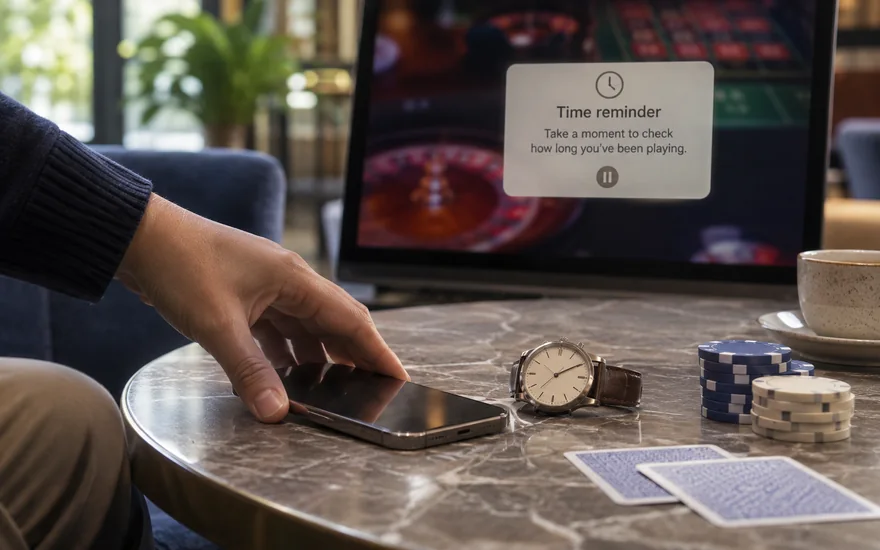
The publication’s local reading prompts concern the article being read. They use editorial text and imagery and can appear during the reading session. They are separate from a casino operator’s reality-check facility. Closing a publication dialog does not acknowledge an operator reminder, change an external account setting or activate a break from gambling.
The resemblance can be confusing: both types of panel may appear after time has passed. Their roles are still separate. An operator's reminder follows its technical standard and implementation; the publication's prompt helps readers navigate and read local articles. The privacy page describes that feature and its session-storage behaviour. A similar appearance does not mean that either panel changes the other service's settings.
An illustration on this article is also explanatory material rather than a live account tool. It cannot measure your gambling session or confirm that a particular operator has interrupted play. To understand or change an actual setting, use the genuine account information. To stop access, use the appropriate real control rather than relying on a panel displayed by this publication.
Stopping does not require finishing the analysis
A reader can decide to stop before resolving every timer question. Understanding the difference between two durations can be useful, but it is not a prerequisite for taking a break. If the session has become uncomfortable, leave the gambling task and use the relevant access or support route. The article does not require a final wager or a completed sequence of reminders.
The practical next step depends on the intended change. A temporary pause points towards the time-out guide. A continuing restriction points towards self-exclusion and current official coverage information. A question about existing money points towards account history or administrative balance return. These routes can be used separately, and a money issue does not need to become a request to restore gambling access.
A reminder's useful role is to make time visible within the session arrangement the operator defines. It cannot assess affordability, diagnose a condition or set a suitable amount of play. If that information is not enough for what you need, you can choose a different tool. You do not have to respond perfectly to every prompt before deciding that a break or more support would help.
Questions and answers
What is a casino reality check?
A display of elapsed session time that appears at a selected frequency and needs acknowledgement to be removed.
Does it stop me gambling for the day?
No. It is not a time-out or a daily-loss cap, although acknowledgement interrupts starting another game as described by the standard.
Why do two products show different session times?
They may use different permitted session implementations. Read the operator’s explanation of account-level or product-level timing.
Can I use the reminder to leave?
The technical guidance says it should offer an exit or log-out facility according to the implementation, alongside access to history.
Sources and scope
Reviewed 10 November 2026. GB means England, Scotland and Wales. Provider examples do not establish availability on every account.
- Session clocks and reality checkswww.gamblingcommission.gov.uk
- Account balance and transaction history requirementswww.gamblingcommission.gov.uk
- Remote time-out and self-exclusion provisionswww.gamblingcommission.gov.uk