



In this guide
- The issuer decides whether another action is needed
- Follow the named transaction, not the message’s urgency
- Keep the stages separate
- If a bank challenge does not complete
- Protect the information around the challenge
- Name the stage before interpreting the result
- Read a challenge as a specific proposed action
- A frictionless flow still needs a ledger check
- Distinguish a challenge problem from a payment refusal
- Make one private timeline from the existing evidence
- Explain a discrepancy without multiplying the attempts
- Keep authentication secrets out of troubleshooting material
- A payment check does not remove protective controls
- Compare methods at the same point in the journey
- Use precise language when a message mentions verification
- Keep the bank answer separate from the account-credit answer
- An unresolved field is better than an invented explanation
- Check the final summary before sharing it
The issuer decides whether another action is needed
EMV 3-D Secure allows transaction, payment-method and device information to be exchanged for authentication. The issuer evaluates the information and may complete authentication without requiring a separate interaction. This is commonly described as a frictionless flow.
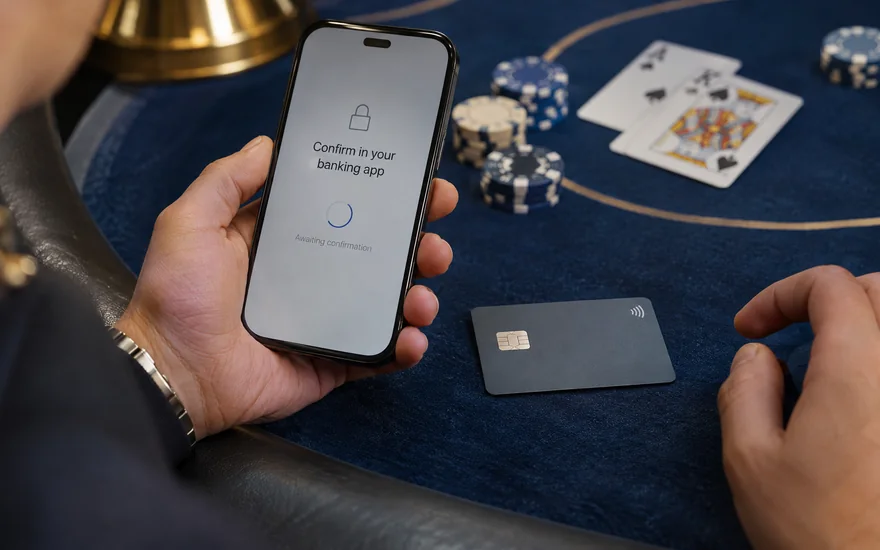
A challenge asks you to do something more, such as confirm the payment in your banking app. The screen and instructions depend on how your bank has implemented the process. An illustration in a guide cannot reproduce the interface every issuer uses.
Follow the named transaction, not the message’s urgency
Read the merchant and amount shown in the genuine bank channel. An authentication request for a transaction you did not initiate should not be approved simply because another message calls it a security check.
If you arrived through an unexpected text or email, leave that route and open the genuine banking app independently. Never dictate a one-time code to someone who claims it is required to release a casino withdrawal.
Keep the stages separate
Authentication concerns whether the person or transaction is recognised through the issuer’s checks. Authorisation concerns whether the issuer permits the payment. The merchant-side account entry then concerns what the operator records against the gambling balance.
These stages can produce different notices. A completed authentication screen therefore does not, by itself, resolve a missing balance entry. Use references and timestamps to identify which stage needs an explanation.
| Stage | Main question | What it does not establish |
|---|---|---|
| Authentication | Is the payment authenticated through the issuer’s process? | That the payment will be authorised |
| Authorisation | Will the issuer permit this payment? | That the operator has posted the account entry |
| Account record | What movement has the operator recorded? | That a later withdrawal is approved |
If a bank challenge does not complete
Use the bank’s published support channel if its app or authentication process fails. Record the wording of the error and the time. Avoid approving multiple unclear prompts while trying to determine which payment they belong to.
Do not change payment routes to defeat a gambling block or a customer-set limit. Authentication is a security control, not a substitute for those protections. A bank can explain the boundary of its own controls without requiring a new gambling transaction.
Protect the information around the challenge
A checkout may request card information through an appropriate secure flow. This does not justify sending a complete card photograph or authentication code in an unsolicited chat. Limit any support report to the information genuinely needed to identify the problem.
If a password or banking approval has been exposed, stop using the suspicious channel and contact the relevant provider independently. The phishing guide distinguishes a suspicious message from a compromised account and lists the records worth keeping.
Name the stage before interpreting the result
Several messages during a card payment may sound like confirmation. One may mean the issuer recognised the customer, another that it permitted the charge, and another that the operator credited the account. Read each message in that context. Authentication confirms only that stage; it does not show that money has reached the gambling balance. If the screens disagree, identifying which stage each message concerns makes the support question much easier to answer without assuming that every stage succeeded.
Suppose you request a £35 deposit, approve the bank challenge and then see an operator error. In this illustrative example, you have three observations: the amount you intended, the authentication result and the error at the merchant. You still need an explanation of what reached the account. Keep the exact wording and time for each screen. Support can then investigate the missing stage, with no need to describe the payment as successful throughout when the records do not yet show that.
This distinction works in the other direction too. A deposit appearing in history is an operator record, but it does not describe every interaction that occurred inside the issuer's authentication process. The absence of a visible challenge should not be rewritten as evidence that no authentication occurred. The public source explains the possibility of frictionless and challenged flows; a private payment still needs its own records to establish what happened to the money.
Read a challenge as a specific proposed action
If the genuine banking channel asks for approval, compare its amount, currency and merchant with the payment you initiated. Do this before approving, rather than relying on what the earlier page said you were doing. An unrelated prompt can arrive while you are expecting a legitimate one. Being in the middle of a payment is therefore a reason to read the details carefully, not a reason to approve every prompt that appears during the same period.
Suppose an approval screen shows £180 when you intended to pay £18. The amounts in this example clearly differ. Note the mismatch and leave the unclear request; approving it and hoping for an adjustment does not correct the displayed amount. A caller saying the extra zero is a routine test does not change what the bank is asking you to authorise. If you need the prompt explained, contact the genuine issuer through a channel you opened independently.
Merchant wording may also need explanation. This guide does not supply a list of universal statement descriptors or claim that every unfamiliar name is fraudulent. The relevant bank or merchant can explain the actual descriptor. Record the wording as shown and ask about that specific request. Do not substitute a guessed company name, as doing so can disconnect the support enquiry from the very detail that needs to be investigated.
A frictionless flow still needs a ledger check
A customer may complete checkout without seeing an extra challenge. EMVCo's explanation allows for authentication that does not require an additional customer action. That makes a quiet flow different from an absent security process. It also means that the visible number of screens is a poor measure of whether a payment should be considered safer, approved or credited. Focus on the resulting confirmation and account entry instead of treating more clicks as proof of a better outcome.
Two separate £20 attempts could show different screens: one might require a bank challenge and the other might not. This example does not make the first guaranteed or the second unverified; it simply illustrates different visible interactions. Each attempt still has its own issuer process and payment records. Do not make repeated £20 payments to compare the screens. Watching which flow appears cannot explain an existing discrepancy, and it adds transactions whose records will also need to be understood.
If the operator confirms a credit, retain the confirmation reference. If no credit appears, ask about the attempted payment using its date, amount and available reference. State whether a visible challenge occurred as an observation, without presenting it as a conclusion about authorisation. This gives support useful context while leaving the unanswered stage open for explanation. It also avoids turning a general description of 3-D Secure into a promise about a particular account.
Distinguish a challenge problem from a payment refusal
Note exactly what went wrong. An app failing to open, a challenge you cannot complete and a displayed refusal from the issuer are different events. Calling all of them a bank problem leaves support unsure whether you were prevented from acting or were shown a payment decision. Keep the time and wording of what you saw. The issuer can then explain its own message through its genuine support route, using those details to identify the event in question.
In a hypothetical case, the banking app opens but displays no matching request. The next useful step is to establish which payment attempt the app was expected to recognise. It is not to approve an old prompt for a similar amount or to start several new deposits. Matching only the amount is insufficient when multiple requests exist. The date, sequence and reference help distinguish the request you intended from another interaction that happens to look similar.
Likewise, leaving a challenge does not by itself explain the final account state. Check the actual bank and operator records before claiming that the payment disappeared, completed or returned. A support enquiry can describe the unfinished challenge and ask whether the associated payment was recorded. This preserves uncertainty rather than converting an interface problem into an invented payment outcome. The transaction-history guide covers the later task of reconciling entries once their meanings are known.
Make one private timeline from the existing evidence
Begin with the intended operation and then list observations in order: checkout submission, bank prompt, response, operator notice and account-history check. Use the displayed times where available and identify which system supplied each time. A screenshot filename or the time you later saved it is not necessarily the transaction time. If a timestamp is unavailable, mark that gap instead of creating a precise sequence from memory that the records cannot support.
An illustrative timeline might show an operator request at 14:05, a bank prompt at 14:06 and a balance check at 14:12. Those are observation times, not a promised processing interval. They do not mean the operator should have credited the account within seven minutes. Their purpose is to help support connect the stages to one attempt and distinguish it from an earlier payment. If an entry is missing or conflicts with another record, the timeline identifies the point that needs an explanation.
Retain the original private evidence but prepare a redacted summary for sharing. A useful timeline can omit passwords, banking codes, complete card numbers and unrelated account activity. Include the case or payment reference only through the appropriate secure channel. If support later provides another reference, record its relationship to the original rather than overwriting the first. Different systems can identify related events differently, and preserving both labels helps future replies stay connected.
Explain a discrepancy without multiplying the attempts
When the bank and operator views differ, ask which stage each record describes. A bank entry is not automatically the same as a final operator credit, while an operator error is not automatically proof that no bank-side record exists. The useful enquiry identifies the exact existing attempt and asks the relevant party to explain its status. Another deposit creates another record and cannot, by itself, establish the fate of the original one.
Imagine two £45 requests made close together: the first produces an unclear message and the second a confirmation. In that example, a single £45 balance entry does not tell you which attempt it belongs to. Compare its reference and time before deciding that the first request is resolved. If both bank records remain visible, ask what each means. Combining them into a £90 total too soon can conceal whether they describe separate payments or different stages of the same operation.
The same principle applies when support offers a general assurance. Ask whether the reply concerns the named payment and what evidence confirms its recorded state. A statement that authentication usually works does not reconcile a particular ledger. Keep the follow-up narrow: the original amount, date, reference and missing event. This is more useful than a broad request to prove that the bank or operator is working normally for every transaction.
Keep authentication secrets out of troubleshooting material
A one-time code or approval belongs in the genuine issuer's flow for the named action. It is different from an ordinary case reference. Someone helping to understand an error should not need to receive the secret used to authorise a payment. Before sharing a screenshot, inspect the whole image, including notification banners and background windows. A cropped error panel may be sufficient, while a full-screen image can inadvertently expose information unrelated to the enquiry.
A hypothetical support message can say that a code was entered at a particular time without reproducing the code. It can quote the displayed result without showing the full card number. This gives the organisation the relevant observation while avoiding a second disclosure. If the genuine service asks for additional evidence, establish what is needed and the secure route for providing it. An unsolicited chat asking for everything at once should be verified independently.
If information has already been shared, tell the genuine issuer what type of information or approval was disclosed. Do not repeat the secret in a public description of the incident. A disclosed password, a disclosed card detail and an approved banking prompt may need different responses from the relevant service. The phishing guide explains how to preserve the message and route the concern without promising that every exposure causes the same outcome or can be reversed.
A payment check does not remove protective controls
Passing an authentication step does not mean that an operator limit, a bank gambling block or a separate account restriction has disappeared. Each control addresses its own question. If a payment cannot proceed because of a protective setting, authentication is not an invitation to seek a different route around that setting. Ask the relevant provider what the control covers and use the support and account tools suited to the underlying concern.
Take an illustrative case where a customer has set a deposit cap but later receives a bank prompt for a payment attempt. The prompt does not show that the deposit is within the cap or give a reason to raise it. Check the operator's active limit separately from the authentication record. The question is what setting applies and what happened to the attempt. An unfinished payment does not need to become a task that must be completed for troubleshooting to succeed.
An existing balance enquiry can remain administrative. You can ask why an earlier payment is recorded without starting a game or removing a break from gambling. If the process is stressful, organise the records with a trusted person while keeping credentials private. The desired outcome is clarity about the existing attempt and appropriate handling of any exposure, rather than proving that another transaction can be authorised successfully.
Compare methods at the same point in the journey
A visible bank challenge and a prepaid voucher PIN are not interchangeable forms of evidence. The challenge concerns an issuer's authentication flow, while the PIN represents prepaid spending authority in its own route. Comparing how quickly the two screens close does not measure the time until a casino withdrawal reaches a bank. Start with the operation and the stage before making a comparison of payment methods, otherwise the comparison mixes unrelated events.
Likewise, a wallet withdrawal window describes a different part of the journey from a card-deposit authentication step. A shorter number in one help page does not show a faster complete route. Identify the start event, end event, currency and destination of each quoted statement. If those differ, explain the difference instead of ranking the numbers. This guide intentionally makes no prediction about the total duration of an unnamed casino payment route.
When comparing records, you could use separate columns for issuer authentication and operator credit. Add only the observations relevant to each. If a later wallet operation exists, record it separately too. This is an illustrative way to organise what you know, without treating a general source explanation as evidence about your own payment. An empty or unclear column also gives the support enquiry a focus: it shows which stage still needs to be explained and which organisation holds that record.
Use precise language when a message mentions verification
Verification can refer to identity, ownership of a payment instrument, a financial check or issuer authentication. The word alone does not establish which process is happening. Ask the genuine sender what the request is for and which account or payment reference it concerns. A request for an identity document is not the same action as approving a card payment, even if both appear during the broader process of funding an account.
Suppose a hypothetical operator notice requests information about a payment instrument after an earlier bank challenge. The earlier authentication does not automatically answer that later request, because the purposes may differ. Equally, the existence of a plausible payment-ownership purpose does not authenticate an unexpected email requesting documents. Open the genuine account independently, find the corresponding notice or contact support, and retain the explanation linking the request to the relevant record.
Avoid inventing a universal document list or deadline when asking about the process. The actual service should explain what it requires for the named issue. You can ask about purpose, secure submission and the next administrative step without supplying unnecessary information. This keeps the support conversation focused and avoids treating 3-D Secure as an all-purpose label for every check associated with a gambling account.
Keep the bank answer separate from the account-credit answer
Once the bank explains its authentication record, record that answer narrowly. If the operator has also reconciled the credit, retain its answer alongside it. If the credit remains unexplained, leave that point open and continue with the relevant ledger enquiry. A completed answer at one stage should not silently close all the questions in the timeline. This is particularly useful when different support teams respond with similar words such as approved or completed.
A closing note could say that the issuer confirmed the authentication interaction and the operator later identified the matching deposit reference. That illustrative wording records two answers; it says nothing about whether another payment will succeed. If only the issuer has replied, leave the operator credit unresolved. Keeping the result tied to what each organisation actually confirmed prevents a general explanation of the process from becoming a claimed observation about an account this publication has never accessed.
The public source date remains the date of the cited material check. Your own timeline has its own dates, and a support reply has another. Keep those dates visible rather than presenting this page as a newly refreshed report whenever you revisit it. Use the payment-security page for handling sensitive information and the transaction-history page for the ledger calculation. The authentication guide's role is to identify the issuer stage and the limits of what that stage proves.
An unresolved field is better than an invented explanation
If you do not know whether the issuer authorised the payment, record that as unknown. If the operator has not supplied a matching entry, record that gap too. The absence of an answer is a reason for a focused question, rather than a reason to call the payment guaranteed, declined or refunded. Precise uncertainty makes later evidence easier to interpret because it does not have to undo a conclusion that was never supported.
Keep the original error wording even when a later answer clarifies it. That preserves the relationship between what you saw and what the relevant organisation explained. A short summary can then distinguish observation from interpretation: the screen displayed a message, and support explained which stage it concerned. This is enough to make the enquiry reviewable without creating a universal rule from a single experience or repeating the payment as a test.
Check the final summary before sharing it
Before sending the summary, check that words such as successful or completed name the system they refer to. A vague statement that the payment completed may need to become a narrower description of what the bank or operator showed. Include the amount and currency, and check that any copied reference belongs to the intended attempt. Remove bank codes or credentials that have slipped into the text. This last read makes the question clearer and avoids disclosing information the recipient does not need.
Questions and answers
Why was there no 3-D Secure code?
The issuer may authenticate without a separate challenge. The absence of a code screen does not prove that no authentication took place.
Does passing 3-D Secure guarantee a deposit?
No. Authorisation and the operator’s account entry are separate stages.
Can support ask me to read out the bank code?
Do not share one-time banking authentication codes with a caller or chat agent. Use the bank’s genuine channel.
Is 3-D Secure an identity-document check?
No. Card-payment authentication and an operator’s identity-document checks have different purposes.
Sources and scope
Reviewed 10 November 2026. GB means England, Scotland and Wales. Provider examples do not establish availability on every account.
- Authentication and authorisation distinctionwww.emvco.com
- Card code data handlingwww.pcisecuritystandards.org
- Recognise and report suspicious messageswww.gov.uk