




In this guide
- Use baccarat values before the draw table
- A natural ends the drawing sequence
- When Player has drawn, read the actual third card
- Trace one hand without inventing a win
- Drawing and settlement are different rules
- Check a surprising draw against the right inputs
- Keep the opening totals beside the added-card value
- Convert picture cards before adding the hand
- Retaining the final digit is not ordinary rounding
- The natural check can override a low total on the other hand
- Player draws on zero through five when there is no natural
- Player six or seven leads to a simpler Banker check
- Banker zero, one or two draws after any Player third-card value
- Banker three has one specifically named exception
- Banker four draws within the two-to-seven interval
- Banker five uses the narrower four-to-seven interval
- Banker six draws only against a six or seven third card
- Banker seven remains a stand in the conditional table
- Label what the eight represents
- Changing a wager cannot select another standard draw
- A completed tie does not explain the earlier draw by itself
- A verification note needs the exact variant and the stage
- Keep a card-value diagram separate from a payout illustration
- Test the branch using a deliberately changed input
- Leave a missing card unknown
Use baccarat values before the draw table
Aces count as one; tens and picture cards count as zero. Other cards use their face value. For a total above nine, keep the final digit. For example, seven plus eight gives a baccarat total of five, not fifteen.
These are hand values, not stake amounts. The labels Player and Banker name two hands in the game; they do not mean that the person who chose a Banker wager decides which card is drawn.
A natural ends the drawing sequence
If either initial two-card hand totals eight or nine, the natural rule stops additional cards. This check comes before applying a low total on the other side. Otherwise a reader can incorrectly call for a third card against a natural.
If there is no natural, Player draws on zero to five and stands on six or seven. Where Player stands, Banker draws on zero to five and stands on six or seven. Where Player draws, use the conditional Banker table below.
When Player has drawn, read the actual third card
Use Banker’s initial two-card total down the left side and the value of Player’s added card across the rule. A Player third card of ten, jack, queen or king has value zero for this purpose.
Do not substitute Player’s final hand total for the third-card value. Those can be different numbers and can produce the wrong Banker decision. The well-known exception is Banker three against a Player third-card eight: Banker stands.
| Banker two-card total | Draws when Player’s third-card value is | Otherwise |
|---|---|---|
| 0, 1 or 2 | Any value | Draw |
| 3 | 0, 1, 2, 3, 4, 5, 6, 7 or 9 | Stand against 8 |
| 4 | 2, 3, 4, 5, 6 or 7 | Stand |
| 5 | 4, 5, 6 or 7 | Stand |
| 6 | 6 or 7 | Stand |
| 7 | No value | Stand |

Trace one hand without inventing a win
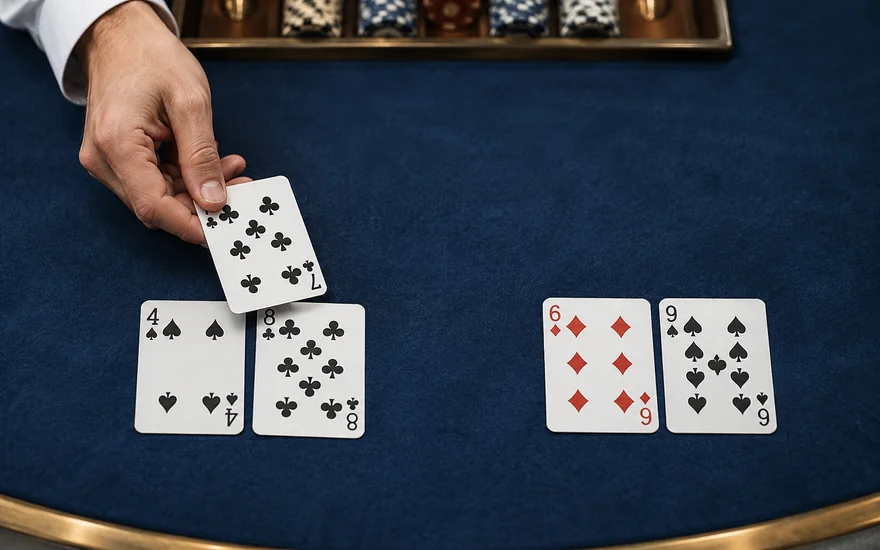
Consider a hypothetical Player hand totalling five and Banker hand totalling three, with no natural. Player draws an eight. Player’s final total becomes three because only the last digit of thirteen counts.
For Banker, the relevant comparison is the third card eight against the initial total three. Banker stands under the exception. Both final totals are three. This example explains the draw decision; it assigns no stake, payout or prediction to a future hand.
Change only the Player third card to two. Banker three now draws because the exception no longer applies. The result of that additional card is still unknown until it is dealt. A fixed decision rule does not make the next card predictable.
Drawing and settlement are different rules
The third-card table determines whether another card is dealt. It does not specify commission, side-bet payouts or every treatment of a tied result. Those belong to the table’s separate settlement rules.
A variant can change the payment terms while retaining familiar drawing rules. Read the named product’s help rather than assuming that a title containing baccarat reproduces every detail of standard punto banco. Do not import a side-bet trigger into the main drawing sequence.
Check a surprising draw against the right inputs
Record the two initial totals, whether a natural appeared and the value of Player’s third card. Those inputs are enough to follow the standard drawing decision. The amount wagered and a previous round’s result do not select the next card under these rules.
If the table help differs, establish the exact variant before treating it as an error. This guide uses published casino rule descriptions for the standard sequence. It does not claim a tested live session or availability at any particular online operator.
Keep the opening totals beside the added-card value
Write down the four opening cards before following the draw table. Convert their values, calculate the two initial totals and check both hands for a natural. If that check allows play to continue, record any Player third card separately. Keep the opening totals visible throughout: replacing one with a later total can send you to the wrong Banker row, even when the final arithmetic is correct.
A worksheet needs separate spaces for Player’s initial total, Banker’s initial total, Player’s added-card value and the completed totals. That may look like more detail than a short hand requires, but each value has a different job. The Banker drawing decision may use an opening total and the added card. Comparing the completed hands comes later, so a single unlabelled total cannot do all the work.
Convert picture cards before adding the hand
Convert the card rank to its baccarat value before looking across the table. A jack, queen or king contributes zero; an ace contributes one. If Player’s third card is a king, use the zero entry when checking Banker’s rule. Its printed rank does not make it thirteen for this purpose, and the value of that card should not be replaced by Player’s completed hand total.
Consider a hypothetical initial hand containing a queen and a seven. Its baccarat total is seven. Another hand containing a ten and a seven also totals seven because both picture cards and tens contribute zero. These examples explain value conversion only. They say nothing about the next card, whether a wager has been placed on that hand or how a specialised side bet treats the card ranks.
Retaining the final digit is not ordinary rounding
Add the baccarat card values, then keep the last digit. Twelve therefore becomes two, and eighteen becomes eight. There is no rounding to the nearest ten, and no money or commission enters this calculation. You are finding a hand value to use in the drawing rules. Keeping the calculation in that order makes it easier to spot a mistaken ordinary sum in a worked example.
In a hypothetical example, six and seven produce thirteen, so the initial total is three. If that hand later receives a five, the sum of the three card values is eighteen and the completed total is eight. The later eight is not an initial two-card natural. Keeping the number of cards and the stage beside the value prevents a final eight from being used retrospectively to stop a draw that was valid earlier.
The natural check can override a low total on the other hand
If either initial two-card hand is eight or nine, the natural condition ends the drawing sequence. A low total on the other hand does not reopen it. This priority explains why a Player hand that would normally draw on its own total may receive no further card when the opposite initial hand is a natural.
For a hypothetical illustration, Player initially totals four and Banker initially totals eight. Checking only Player’s four would lead to the wrong next step. Check both initial hands first: the eight establishes the natural branch, so additional drawing stops. No payout is assigned here. The example concerns the priority of the drawing condition, while the completed-hand comparison and the wager’s settlement remain separate questions.
Player draws on zero through five when there is no natural
With no opening natural, Player draws on zero, one, two, three, four or five. This settles whether a card is taken, without saying what that card will be. The dealer or software follows the fixed instruction; there is no hit-or-stand choice for the person who placed a wager. Until the card appears, any later decision that needs its value must remain open.
For a hypothetical pair of opening hands, Player’s nine and six total five after retaining the final digit, while Banker’s two and four total six. There is no natural. Player therefore draws under the standard rule. At this point, leave the Player third-card field blank until the card is known. Banker’s six alone is not enough to finish the conditional decision while the Player third card is unresolved.
Player six or seven leads to a simpler Banker check
If Player stands on six or seven and neither opening hand is a natural, skip the conditional third-card table. There is no Player third card to look up. Instead, Banker draws on zero through five and stands on six or seven. Trying to fill in a third-card value in this situation creates an input the hand never had and can lead you into the wrong rule.
Imagine a hypothetical Player total of six and Banker total of five. Player stands; Banker draws under the no-Player-third-card branch. Change only Banker’s initial total to six, and Banker stands. The difference follows from the initial Banker total in that branch, rather than from a hidden assumption about Player’s next card. This is a useful contrast with the cases where Player actually draws and Banker six needs the conditional table.
Banker zero, one or two draws after any Player third-card value
Once Player has drawn and no earlier natural has ended the sequence, Banker initial totals of zero, one or two draw regardless of the Player third card’s value. The table therefore gives a broad row for these totals. It should not be confused with a claim that Banker always draws in every opening situation, because the natural check and Player branch still come first.
Suppose Player starts at four and draws a picture card worth zero. Banker’s opening total is two, so Banker draws. Now change only Player’s added card to eight: Banker two still draws. Neither version tells you what Banker receives next, or whether the final totals match. The comparison simply shows that this row gives the same drawing instruction for those different third-card values, once the earlier checks have been made.
Banker three has one specifically named exception
When Player has drawn, Banker three draws against every third-card value except eight. This exception concerns the value of the actual added card, not whether Player’s completed hand totals eight. A picture card worth zero belongs to the drawing side of the row. The exact input matters because the same final Player total can arise from different opening totals and added cards.
Consider two hypothetical Player hands. One starts at five and receives eight, finishing at three; another starts at one and receives two, also finishing at three. Against Banker three, the first uses the eight exception and Banker stands, while the second requires Banker to draw. Equal Player final totals therefore do not establish equal Banker decisions. The differing third cards are the decisive inputs in this comparison.
Banker four draws within the two-to-seven interval
With a Player third card present, Banker four draws when that card’s baccarat value is two, three, four, five, six or seven. It stands against zero, one, eight or nine. Keep this interval attached to Banker’s initial total four. A different Banker row has a different interval even when the Player added card is identical.
For a hypothetical contrast, Player begins at two and draws a six, completing eight from three cards. Banker begins at four and draws because six is within the stated interval. Change the added six to one while keeping the opening totals unchanged: Banker four now stands. The three-card eight in the first example does not activate the initial-natural rule, because that earlier check concerns the original two cards.
Banker five uses the narrower four-to-seven interval
Banker five draws against Player third-card values four, five, six or seven. It stands against the remaining values. This narrower interval is why a general phrase such as Banker draws below six is incomplete once Player has drawn. That phrase describes the separate branch where Player stands, not every conditional row.
Imagine a hypothetical Player initial total of three and Banker initial total of five. Player draws a two. Banker five stands because two falls outside its interval, even though Player’s final total becomes five. Change only the added card to four, and Banker draws. In both cases the decision follows the third-card value and Banker’s initial five. It does not follow the person’s chosen wager or an attempt to improve the lower-looking hand.
Banker six draws only against a six or seven third card
The conditional row for Banker six permits a draw only against Player third-card values six or seven. It stands against zero through five and against eight or nine. This row is particularly useful for checking why the same initial Banker total can stand in one hand and draw in another without any discretionary decision.
Take an opening Player total of two and a Banker total of six. If Player adds a six, Banker draws; if Player instead adds a five, Banker stands. You can check that difference directly against the row for Banker’s initial six. Player’s completed total is not the value being looked up. In the draw example, leave Banker’s added card and the eventual result unknown until the card is actually supplied.
Banker seven remains a stand in the conditional table
When the conditional table is reached, Banker seven stands regardless of Player’s added card. The table does not instruct Banker to draw merely because Player’s completed hand appears stronger. Standard punto banco uses its drawing rules rather than a discretionary attempt to beat the visible opposing total.
For a hypothetical example, Player begins at five and adds a four, completing nine with three cards. Banker begins at seven and stands. The Player’s final nine is not a natural and does not alter Banker seven’s row. This sequence can look surprising if a reader expects blackjack-style hit decisions. Recognising the fixed procedural rule explains it without attributing strategy or choice to the person who backed either hand.
Label what the eight represents
The number eight can appear in several fields of a hand record. It may be an initial natural total, the value of Player’s third card or a final total formed with three cards. Those facts can have different consequences. Label the field rather than recording a bare eight and asking the table to infer what it means.
A hypothetical Player initial two plus a third-card six gives a final eight. Against Banker three, the relevant conditional input is six, so Banker draws. An initial Player five plus a third-card eight gives a final three; Banker three stands under the eight exception. The examples reverse the intuitive emphasis on the final total and show why preserving the added-card field is essential. Neither assigns a cash outcome.
Changing a wager cannot select another standard draw
The labels Player and Banker name hands. Choosing a wager on one of them does not give the customer control over its drawing decisions under standard punto banco. The standard inputs remain the card values and drawing sequence. Stake size, a previous loss or a preference for one hand does not replace a row of the table.
Explaining a draw is different from recommending a wager. Given the stated opening totals and added card, you can check why Banker must draw. That does not tell you which hand to back on the next round. A recommendation would need information about the wager’s terms and probabilities that this drawing table does not provide. Keep the worked example focused on the decision the known cards allow you to verify.
A completed tie does not explain the earlier draw by itself
The original worked sequence finishes with equal totals after Player’s added eight causes Banker three to stand. The equality is the result of the completed values, not the input that instructed Banker to stand. Looking backwards from a tie without the original cards can therefore conceal several different valid drawing histories.
For a hypothetical reconstruction, record the initial totals and the actual added cards before describing the final comparison. If the image shows only the completed totals, state that the drawing history is missing. Settlement terms for a tie, including any side wager or variant treatment, require their own rules. The fact that a final comparison is tied cannot supply those terms or prove which conditional row was used.
A verification note needs the exact variant and the stage
This guide explains the standard punto banco sequence using the dated sources listed below. A product with another name or specialised settlement terms may need additional checks. Start with the exact table title, then identify whether the question concerns initial totals, the drawing branch or payment. Those questions require different pieces of evidence.
For a query about an unexpected draw, give both initial totals, say whether a natural was present and identify Player’s actual third card. Then ask which instruction made Banker draw or stand. Those details let someone check the standard decision without another wager being needed. If the recording starts mid-hand or omits a card, say so; the final score should not be used to quietly fill that gap.
Keep a card-value diagram separate from a payout illustration
A useful diagram for this topic can show the two opening hands, a natural check and the conditional Banker branch. It should label card values and totals. Adding GBP amounts to that diagram would introduce a separate settlement question and is unnecessary to explain whether a card is drawn. Keeping the diagram procedural makes its purpose clear.
Follow the question when choosing another guide. Blackjack insurance deals with an optional side stake; roulette wheels deals with the possible outcomes on a wheel. Neither explains baccarat’s added-card decision, despite all three being table-game topics. For this article, a complete explanation identifies the correct drawing branch. If another card is still to be dealt, it can finish there without inventing the final result or adding a payout example.
Test the branch using a deliberately changed input
One way to check an explanation is to change a single input while preserving the others. Start with a hypothetical Player initial five, Banker initial three and Player added eight. Banker stands. Replace only the added eight with a seven: Banker three now draws. The changed decision follows the explicit exception, so the explanation should name that difference rather than saying that the hands simply looked stronger or weaker.
You can also keep Player’s added card fixed and change Banker’s opening total. With a Player third card worth two, Banker four draws but Banker five stands. This tests whether the explanation chose the correct row as well as the correct card value. It is a way to check your reading of the table. It does not forecast a hand or suggest that anyone can change a wager after seeing the cards.
Leave a missing card unknown
If a recording shows that Player drew but hides the added card, the conditional Banker decision cannot always be reconstructed. Some rows may give the same decision across several possible values, while others have decisive exceptions. State the known initial totals and mark the missing added-card value. Do not infer the card from the final total unless the full arithmetic and available information uniquely establish it.
If you work out a possible missing value, label it as an inference rather than something visible in the recording. A clearly shown card provides stronger evidence of the sequence than a guess from a cropped scoreboard. The drawing rules can be exact even when the record is incomplete. That is especially relevant with Banker’s opening three: knowing whether Player’s third card was eight may be essential to explain the stand exception.
Questions and answers
Does Player choose whether to draw in baccarat?
Not in standard punto banco. The drawing rules are automatic.
When does Player draw a third card?
First check that neither opening hand is a natural. If there is no natural, Player draws on zero to five and stands on six or seven.
Why does Banker stand on three against eight?
When Player’s third-card value is eight, Banker three is the specific stand exception in the conditional table.
Do I use Player’s final total for the Banker table?
No. Use Player’s actual added-card value and Banker’s initial two-card total. Player’s final total may be a different number.
Does a natural stop both hands drawing?
Yes. In the standard sequence described here, an initial two-card total of eight or nine on either side stops further drawing.
Sources and scope
Reviewed 10 November 2026. GB means England, Scotland and Wales. Provider examples do not establish availability on every account.
- Punto banco third-card drawing table; rules only not GB product availabilitywww.venetianlasvegas.com
- Punto banco drawing order; rules only, no GB availability claimwww.mgmresorts.com