


In this guide
- What is actually being insured?
- Why it is an additional stake
- Read profit and total return differently
- Even money concerns a natural in the player hand
- The offered payout is not the probability of the event
- What insurance does not change
- Name the side-bet event before looking at the player total
- The ace opens the insurance choice; it does not reveal the result
- A half-size side stake increases the total amount committed
- Successful insurance returns its own stake as well as profit
- A losing side stake can coexist with several main-hand outcomes
- An offset in one outcome does not make insurance free
- Expected value requires a probability that the payout does not supply
- The break-even threshold can be checked with hypothetical probabilities
- Even-money equivalence depends on the natural payout assumption
- Do not call a natural every hand totalling twenty-one
- Other side bets keep their own stake and event definitions
- Splitting and doubling belong to other decisions
- Match the returned amount with the stake that funded it
- A partial recording can show an offer without showing acceptance
- The rule source is a product example rather than an operator ranking
- Time information and funding limits answer different questions
- Check the insured event before querying a result
What is actually being insured?
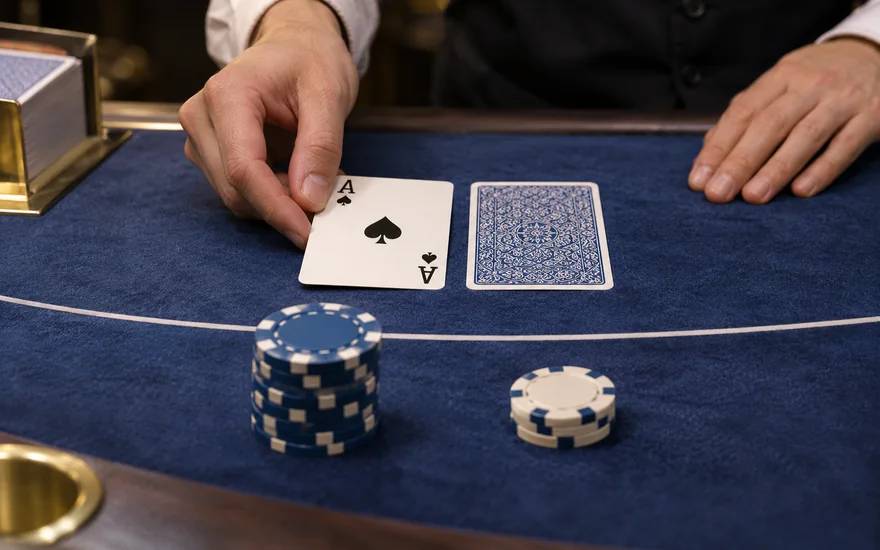
The relevant event is the dealer completing a two-card blackjack. In the published All Bets Blackjack RNG rules at Grosvenor, an ace upcard triggers the insurance choice, the extra stake equals half the original bet, and successful insurance pays 2:1.
If the dealer does not have blackjack, that insurance stake is lost and the ordinary hand is still resolved under its own rules. A dealer reaching 21 with additional cards is not the same event as the two-card natural described by the insurance rule.
Read the rules for the table in front of you. This example cannot establish the timing or terms of every blackjack variant, especially one with unusual side bets or dealing rules. A familiar insurance label is a reason to check those details, rather than assume another game’s help applies.
Why it is an additional stake
Suppose an ordinary main bet is £10 and the insurance stake is £5. The player has committed £15 in total, not merely protected the original £10 for free. The side bet adds an exposure that did not exist before it was accepted.
If the dealer has blackjack and the ordinary main hand loses £10, successful insurance earns £10 profit on the £5 side bet, with the insurance stake returned as well. In this hypothetical case, the side-bet profit offsets the main-hand loss. The combined net result is zero, although extra money was committed to obtain that result.
If the dealer does not have blackjack, the £5 side bet loses. The main hand can subsequently win, lose or tie according to its own outcome. Losing insurance does not settle that main hand, and winning a later main hand does not retroactively make the insurance stake successful.
| Hypothetical event | Main bet | £5 insurance | Combined net effect |
|---|---|---|---|
| Dealer blackjack; ordinary main hand loses | −£10 | +£10 profit | £0 |
| Dealer no blackjack; main hand later loses | −£10 | −£5 | −£15 |
| Dealer no blackjack; main hand ties | £0 | −£5 | −£5 |
Read profit and total return differently
A payout described as 2:1 means two units of profit for each successful insurance unit. Including the returned side-bet stake, that winning bet returns three units. Confusing those figures can make the apparent compensation look smaller or larger than it really is.
The same distinction applies when reading an account history. An interface may show the stake and gross return as separate entries. Reconcile the two before calling the displayed return a profit. The example amounts on this page are arithmetic, not a record of a tested gambling session.
Even money concerns a natural in the player hand
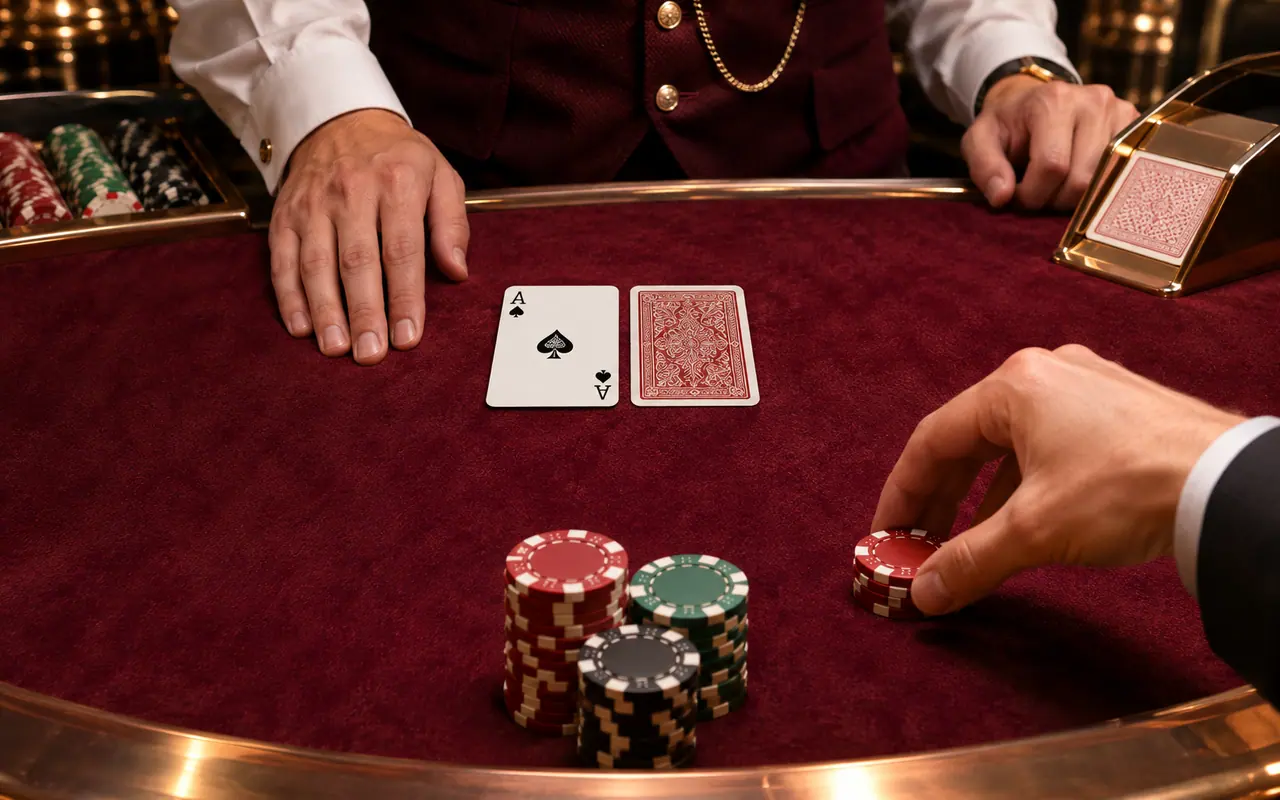
When the player already has a natural, some tables offer an even-money decision against a dealer ace. Its relationship to insurance depends on the main-hand payout and the exact table rules. It should not be treated as a new, universally available feature.
For a hypothetical game paying a natural at 3:2, a £10 natural wins £15 when the dealer does not have blackjack. Adding £5 insurance would lose that £5 in this branch, leaving £10 profit. If both sides have naturals, the main hand pushes and winning insurance supplies £10 profit instead.
That explains why insurance can produce the same net result as an even-money choice in that particular example. It does not establish that the choice improves the underlying value of the hand, and the equivalence should not be carried into a different main-hand payout without recalculating.
The offered payout is not the probability of the event
A 2:1 insurance payout is a settlement rule. It does not mean the dealer’s hidden card has a one-in-three chance of completing blackjack. The probability depends on the cards and game conditions, while the posted payout can stay the same.
In a purely hypothetical probability calculation, a side bet with two units of profit when it wins and one unit lost otherwise has expected net value of three times the winning probability minus one. Break-even would require a probability of one third. This is a mathematical boundary, not a prediction for a live hand.
Do not use the dealer’s ace or a recent sequence of outcomes as evidence of a guaranteed insurance result. This page explains settlement rather than providing a card-counting system or a recommendation to add side bets.
What insurance does not change
The side bet is distinct from splitting, doubling and the later decisions on an ordinary hand. It also does not reimburse every other side bet. The checked Grosvenor rules explicitly separate insurance from the additional side bets offered in that release.
Extra options on a table can create several simultaneous stakes. Read each one independently instead of assuming the insurance label covers the full amount on screen. If the total commitment is unclear, decline the additional action and consult the help before continuing.
Session controls remain separate from game settlement. A time reminder does not reverse an insurance loss, and a deposit cap does not limit the number of side bets that can be funded from an existing balance. Taking a break is an available choice without needing to resolve the next hand.
Name the side-bet event before looking at the player total
The insurance event in the checked rule is the dealer having a two-card blackjack. The player’s own total is relevant to the main hand, but it does not redefine that side-bet event. A poor-looking player hand does not make insurance cover all later dealer wins, and a strong-looking player hand does not change the posted insurance payout.
When writing down a hand, put dealer natural beside the insurance stake and main-hand outcome beside the original stake. That small distinction helps prevent the two settlements getting mixed together. A dealer twenty-one made with additional cards is outside the two-card event named in the insurance rule. Here, insurance is the name of a specific wager; it does not promise to preserve everything committed on the table.
The ace opens the insurance choice; it does not reveal the result
The dealer’s ace explains why the insurance offer appears in the checked rules. It does not tell you what the hidden card is. An offer and a successful bet are different stages: the option may be available, accepted and then lost. Keep that sequence in mind when reading a screen that shows the insurance button but has not yet shown the dealer’s result.
A hypothetical interface record can show the dealer ace, the available insurance decision and the later dealer check as separate events. The first event explains why the option appeared. The later event resolves whether its particular outcome occurred. If a recording ends at the offer, its final insurance result remains unknown. Do not infer that the attractive label or the appearance of the button means the insured event has happened.
A half-size side stake increases the total amount committed
In the published example rule, insurance equals half the original stake. If the main stake is represented by M, the insurance stake is M divided by two and the combined commitment is one-and-a-half times M. This arithmetic describes the two simultaneous exposures, not a new main-hand payout rule.
Put the original stake and the optional insurance stake on separate lines in an example ledger. Their proximity on the table can make the extra commitment easy to overlook, but both amounts have been put at risk. Declining insurance leaves the main hand to settle under its own rules. Accepting it adds a wager on the specified dealer event; the offer itself has not refunded any of the original stake.
Successful insurance returns its own stake as well as profit
At the stated two-to-one profit payout, one successful insurance unit produces two units of profit plus the returned insurance unit. Gross return is therefore three units for that side stake. Net profit is two. These quantities must be labelled before they are compared with the main hand’s loss or an account credit.
An example ledger could show a one-unit insurance debit followed by a three-unit winning credit. Subtracting the debit leaves a two-unit gain on the side bet. The credit on its own is the gross return, however prominently it appears in a summary. This is an arithmetic illustration, rather than a claim about an operator’s screen layout. Different labels can describe the same settled bet, provided each amount is identified clearly.
A losing side stake can coexist with several main-hand outcomes
If the dealer does not have blackjack, insurance loses under the checked rule. The ordinary hand can then continue towards its own win, loss or tie. The later outcome does not change the side bet’s event. A main-hand win cannot retrospectively turn a failed dealer-natural wager into successful insurance.
Enter the insurance loss first, then settle the main hand. A push on that hand leaves the side-bet loss in place. If the hand also loses, both losses reduce the balance. If it wins, combine its profit with the insurance loss to find the overall result. The interface may present everything in one closing animation, but keeping the entries separate makes it much easier to see what happened to each stake.
An offset in one outcome does not make insurance free
Insurance offsets the ordinary main-hand loss in the dealer-blackjack example above. It is easy to focus on that outcome and overlook the alternative: when the dealer has no blackjack, the added insurance stake loses. A bet is not free because it cancels a loss in one possible outcome. The amount committed and what happens in the other outcome both belong in any explanation of the cost.
An abstract two-branch diagram can put dealer natural on one side and no dealer natural on the other. Attach the appropriate side-bet result to both. Only then combine the main-hand result relevant to each branch. This makes the trade-off visible without treating the favourable offset as a universal refund. It also explains why a single successful insurance example cannot establish the value of repeatedly accepting the option.
Expected value requires a probability that the payout does not supply
Let p represent the probability of the specific insured event under a stated model. A one-unit insurance stake wins two net units with probability p and loses one with probability one minus p. Weighting those branches gives two p minus the quantity one minus p, equivalently three p minus one. The simpler expression is the expected net result in stake units.
A two-to-one payout alone does not identify p. The break-even condition follows by setting three p minus one equal to zero, which gives one third. This is a mathematical threshold, not a claim that a particular live dealer has that probability. The rule’s settlement terms and the information needed for a probability calculation are distinct inputs. Keep an unspecified probability as a variable instead of inventing a card composition or hidden-card forecast.
The break-even threshold can be checked with hypothetical probabilities
For an independent arithmetic illustration, suppose p is one quarter. Three times one quarter minus one is negative one quarter of an insurance unit. If p is one half in another purely hypothetical model, the expression is positive one half. These examples demonstrate how the formula responds to a defined probability; they do not describe a real blackjack shoe.
These examples explain why the posted payout cannot tell you the value of the wager on its own. The same two-to-one terms produce different expected results when the hypothetical event probability changes. To apply the calculation to an actual hand, you would need relevant evidence about that hand’s conditions. A recent run of results, the ace upcard alone or a screen full of extra options cannot supply the missing probability.
Even-money equivalence depends on the natural payout assumption
The original even-money illustration assumes a natural paid at three to two. Under that assumption, a main stake M wins one-and-a-half times M when the dealer does not have blackjack. Half-stake insurance loses half of M in that branch, leaving M in net profit. The arithmetic uses both the main-hand and side-bet payout assumptions.
If both sides have naturals in that hypothetical rule set, the main hand pushes while successful half-stake insurance supplies M in profit. The equal net outcomes explain the relationship to an even-money decision in that example. Remove or change the natural payout assumption and the equality must be recalculated. The phrase even money does not establish a universal feature or make every blackjack variant share the same two-branch calculation.
Do not call a natural every hand totalling twenty-one
The examples distinguish a two-card natural from twenty-one reached with additional cards. A later total of twenty-one can be relevant to main-hand settlement while failing the particular insured-event definition. A bare scoreboard showing twenty-one may therefore be insufficient to explain insurance unless the number of cards and the relevant stage are known.
If you are checking a recording, keep the dealer’s opening cards or an explicit natural indicator where the game shows one. A clip that begins after further cards have been dealt may not reveal whether the opening hand was a natural. The final total cannot repair that missing view. As with baccarat, a rule may depend on an earlier dealing condition rather than the total visible at the end.
Other side bets keep their own stake and event definitions
A table may show several optional wagers beside the main hand. The checked rules distinguish insurance from additional side bets in that release. Accepting one does not imply that the others are covered or reimbursed. Each needs its own event, stake and settlement terms before a combined net result can be calculated.
For a hypothetical screen annotation, draw a separate box around each stake and label its winning event. Do not use one insurance arrow to cover every chip position. The visual arrangement can be compact while the financial exposures remain distinct. If a result summary groups credits, use the detailed rules or history to identify which wager produced each component rather than attributing the whole figure to the insurance decision.
Splitting and doubling belong to other decisions
Splitting and doubling alter an ordinary hand under their specific rules. Insurance is the separate dealer-natural wager described here. A shared moment of additional commitment does not make those actions interchangeable, and a rule about one does not establish the permitted amount, timing or outcome of another.
An explanatory sequence can therefore pause at the insurance decision and resolve its side event before discussing whatever later main-hand choices the actual product allows. This guide does not invent that later sequence for every table. The exact version’s help supplies its own order. Keeping the questions separate avoids an incorrect claim that insurance automatically covers a doubled stake, a split hand or every later amount shown on the table.
Match the returned amount with the stake that funded it
A debit shows an amount committed; a credit shows an amount returned under the record’s labels. Reading a gross credit without the related debit can overstate profit. Reading a stake debit without a later completed credit can overstate loss. Reconcile the completed wager before describing its net contribution to the session.
For a hypothetical insurance audit, identify the optional stake entry and the final result of the dealer-natural check. Then match the credit or loss to that same event. Keep the original hand’s entries separate until the combined net calculation is needed. If the record is incomplete, state which companion entry is missing instead of guessing from the final balance or the most prominent win animation.
A partial recording can show an offer without showing acceptance
An insurance button appearing on screen is evidence that an option was presented in that observation. It does not establish that the person accepted it, what amount was committed or how the side bet settled. A demonstration screenshot can be useful for locating a control while remaining insufficient for a monetary reconstruction.
Describe only the stage the image shows: an offer, an accepted stake or a settled result. A screenshot of the offer cannot establish the other two. Before matching a later account entry to it, confirm that the entry belongs to the same event. This keeps a useful illustration honest about what was observed, without presenting it as a paid test or evidence that every version has the same insurance option.
The rule source is a product example rather than an operator ranking
The dated Grosvenor rule supplies a concrete GB example of the offer, stake proportion and payout. The MGM material supports the separate-event explanation. Neither source is used here to rank casinos, establish account availability or recommend adding an optional stake. The rule can be explained without an operator call to action.
When checking another product, retain its exact name and read its own help before carrying over timing or payout assumptions. An unfamiliar blackjack variant may change the surrounding conditions while using a familiar word. The relevant comparison is whether the insured event, commitment and settlement match, rather than whether the table artwork looks similar or its lobby category also says blackjack.
Time information and funding limits answer different questions
A reality check can show elapsed session time, while a deposit limit addresses new funding over a defined period. Neither changes whether the dealer’s opening cards form the insured event. An existing balance can fund several optional stakes without any new deposit, so a funding cap is not a calculation of total side-bet exposure.
For a session record, keep the result of each wager alongside a separate running total of stakes and a note of any active account controls. Those entries answer different questions: what settled, how much was committed and what limit or reminder applied. Recording them together can help a reader follow the money without mistaking the insurance option for a spending limit or a reason to postpone a break.
Check the insured event before querying a result
A useful enquiry names the table version, dealer ace offer, optional stake, dealer-natural result and the relevant settlement entry. These inputs identify the exact question. Asking why insurance did not save a losing hand omits whether the dealer had the event being insured and can lead to a misleading general answer.
For a hypothetical reconstruction, begin with the event definition and check the actual dealer opening result. Next check whether the side stake was accepted and recorded. Finally compare its own settlement with the published terms. The main hand can then be reconciled separately. This sequence makes the rule concrete while preserving missing evidence and avoiding the assumption that an ordinary later dealer win must be reimbursed.
A final arithmetic check can use labelled units rather than a fresh cash example. Write side-stake debit, side-bet gross return and side-bet net result separately, then compare the net with the main-hand net only when calculating the combined effect. This avoids comparing a gross credit on one line with a loss on another. If the main hand is a natural, preserve that fact and its actual payout rule before using the even-money illustration. The same two-to-one insurance term cannot supply a missing main-hand payout or prove that the special decision was offered.
Questions and answers
What does insurance mean in blackjack?
It is a separate wager on the dealer having a two-card blackjack. It is normally offered when the dealer’s upcard is an ace.
What does blackjack insurance pay?
The checked rules pay 2:1 profit, plus return of the successful insurance stake.
How much does insurance cost?
In the verified Grosvenor product example, the insurance stake is half the original main bet. Check the particular table’s rules before assuming that amount applies.
Does insurance cover every losing hand?
No. It pays for its specified dealer-blackjack event. A main hand can lose in other ways without the insurance wager winning.
Does insurance matter if I also have blackjack?
It changes the combined settlement. The even-money equivalence described here is conditional on the hypothetical 3:2 natural payout and the stated rules.
Sources and scope
Reviewed 10 November 2026. GB means England, Scotland and Wales. Provider examples do not establish availability on every account.
- GB blackjack insurance rulewww.grosvenorcasinos.com
- Insurance payout and main hand separation; rules onlywww.mgmresorts.com
- Account balance and transaction history requirementswww.gamblingcommission.gov.uk