




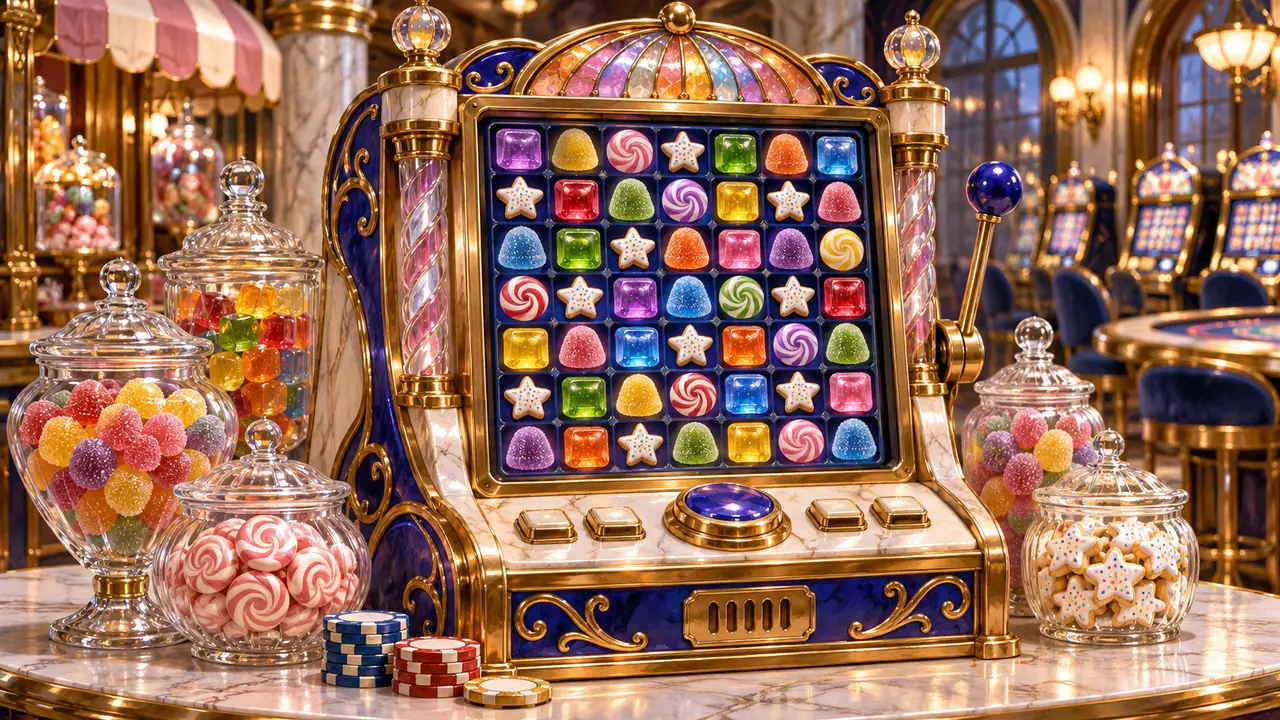
Published facts for Sugar Rush
| Published field | Value and source scope |
|---|---|
| Provider | Pragmatic Play |
| Format | Cluster-pays tumbling slot |
| Grid | 7×7 |
| Published operator RTP example | 94.50% · MrQ published listing |
| Release announcement | 2022-06-30 |
Explore the provider demonstration

Load the provider’s demonstration to view the game interface. It uses a separate provider connection and does not confirm any casino account’s game model.

In this guide
- A hypothetical cluster: a mark is not yet a multiplier
- How do matching symbols connect?
- Which positions keep their values?
- How many scatters start which free-spin award?
- Sugar Rush slot RTP: what does 94.50% mean in this guide?
- Which maximum belongs to which level?
- What is useful to compare with another cluster game?
- Track the address separately from the sweet occupying it
- A shared edge is different from a shared corner
- An isolated matching symbol does not automatically enlarge a group
- Read the mark before looking for a multiplier
- Repeated removals build a doubling sequence with a ceiling
- Do not multiply all visible square values together
- Keep the base-game map within its continuing sequence
- Free-spin persistence uses a broader feature scope
- Read the scatter award from its exact starting count
- An opening count and a multiplier map are independent descriptions
- A high-value square is not a credited balance
- Separate the square ceiling from the published round maximum
- A theoretical percentage does not describe marked-square frequency
- Resolve the final result without counting intermediate state twice
- Compare the retained object with the egg and the blocked board
- Name the square and event when querying a change
- A compact map can explain a sequence without predicting it
A hypothetical cluster: a mark is not yet a multiplier
Imagine an illustrative result with five matching symbols joined in a qualifying group. The winning symbols are removed, new symbols arrive, and their former positions are marked. This is a worked explanation of a game state, not a spin that this publication has played or a forecast of another result.
If a later qualifying removal uses one of those marked positions, it creates a 2 x multiplier there. Further qualifying removals at that address double the value, up to 128 x. A replacement symbol merely landing in the square does not meet that condition. Follow winning use of the position, not every arrival, to explain when its value changes.
This sequence separates three events that can look similar during an animation: marking a square, establishing its first multiplier and increasing that multiplier again. Reading them separately avoids attributing a finished multiplier to every coloured overlay on the screen.
How do matching symbols connect?
Pragmatic Play’s original launch announcement describes a seven-by-seven grid and a minimum of five matching symbols. The symbols in a cluster must connect horizontally or vertically. A diagonal touch on its own does not satisfy that description of adjacency.
This is a cluster rule rather than a set of fixed line paths. The relevant questions are which symbols belong to a qualifying connected group and what happens to their positions afterwards. A row of visually similar symbols elsewhere on the grid may be separate from that group.
The tumble then supplies another arrangement by replacing the removed symbols. A continuation is still part of the initiating sequence. It should not be counted as another separately purchased spin simply because symbols move again.
Which positions keep their values?
The original game marks positions after winning symbols are removed. In a base-game sequence, those positions and their developing multipliers belong to that spin’s continuation. They are not described as permanent improvements attached to the account or to the next unrelated base spin.
During free spins, the provider says the marked spots and multipliers remain through the entire feature. This persistence changes the state a player needs to follow: a value established earlier in the round can still be present when a later free spin begins.
The visible position is therefore the object to track. The multiplier does not belong to a gummy bear that can be followed elsewhere on the screen. Replacing a symbol and retaining a square’s state are different operations in the described mechanic.
How many scatters start which free-spin award?
The current provider description distinguishes awards by the number of scatters: three award ten free spins, four award twelve, five award fifteen, six award twenty and seven award thirty. The starting award should be read from that trigger, rather than assuming that every feature starts with the largest count.
The number of free spins and the multiplier values describe separate parts of the feature. A larger starting count does not specify where winning clusters will appear. Likewise, a high value already visible on one square does not establish that a later qualifying cluster will use that square.
| Scatters in the starting event | Original published free spins |
|---|---|
| 3 | 10 |
| 4 | 12 |
| 5 | 15 |
| 6 | 20 |
| 7 | 30 |
Sugar Rush slot RTP: what does 94.50% mean in this guide?
MrQ’s current page gives 94.50% for the original title. That figure is retained with its operator source and observation date. It is not a universal provider percentage, and the presence of the same game name on another site does not identify the mathematical configuration used there.
The percentage describes the model’s outcomes over the long run. It creates no amount owed back after a short session, however much has already been staked. Position overlays cannot change that meaning. They show a state governed by the game’s rules, while the next arrangement remains unknown; they are not a reimbursement meter for money spent earlier.
Keep a source beside each number when comparing versions. Averaging different website percentages would produce a new value that might describe none of the actual configurations. The loaded game’s information should identify the particular edition being viewed.
Which maximum belongs to which level?
The provider describes a position value reaching 128 x. Keep that unit and location together: it is a modifier at a square, not the settled result of the whole round. A complete result can involve other qualifying symbols and awards, so the position ceiling cannot be used as a replacement for the separately described round maximum.
MrQ’s original-game page separately describes a maximum of 5,000 times the total bet. That published example should not be replaced by the larger figures advertised for Sugar Rush 1000 or Super Scatter. A familiar sweet theme does not make later titles the same release.
What is useful to compare with another cluster game?
Start with the smallest qualifying group, the adjacency rule and what survives a symbol replacement. Then ask whether a modifier lasts for one continuation or an entire feature. Those details explain more about the playing sequence than matching two screenshots because both contain a large grid.
For a personal time or spending boundary, keep the visible progress separate from the decision to continue. A partly developed grid is an active feature state. It does not represent money that has been earned, nor does it require another funded spin to complete a pattern.
Track the address separately from the sweet occupying it
The original board has seven rows and seven columns, giving forty-nine visible positions. A position can be identified by a row-and-column address even after its occupant changes. That address is the useful object for tracking marks and multipliers. Following a sweet symbol as though it carries a value to another square would confuse symbol identity with the state attached to the location.
Give one square an example address, such as row three, column four. Note the symbol there before a qualifying removal and the new occupant after the tumble. The symbol changes while the address can retain a mark under the relevant sequence rule. This explains what persistence refers to without assuming which sweet arrives next or assigning a value to an outcome that has not occurred.
An isolated matching symbol does not automatically enlarge a group
Counting every matching symbol visible on the screen can overstate a cluster. The minimum applies to a qualifying connected group under the stated rule, not to a colour’s board-wide population. An isolated sixth symbol can remain separate from a connected group of five. Its identity does not bridge intervening cells occupied by other symbols.
Draw a connected five-symbol group and place another matching symbol two columns away in a worked example. Trace only the allowed edges. Without a chain of matching neighbours, the isolated symbol stays outside that group. The screen’s total matching count may be larger, but it does not describe a larger cluster. Keep the separated components distinct unless the actual evaluation instructions establish some other treatment.
Read the mark before looking for a multiplier
The first qualifying removal marks a position. A later qualifying removal at the marked position creates its two-times value. These are distinct stages. A coloured overlay may therefore identify a useful state without yet carrying the first multiplier. Read the displayed label and the event history rather than assuming that every marked position already doubles an award.
An example position history can read unmarked, then marked after a qualifying removal, then two times after the later qualifying removal. Keep each stage at the same address. A symbol arriving between those events is not itself another winning removal, so its arrival does not advance the history. That difference explains why an overlay may stay unchanged through a tumble even though its ordinary occupant has been replaced.
Repeated removals build a doubling sequence with a ceiling
After the first multiplier is established, the provider describes doubling through subsequent qualifying removals at that position up to 128 times. The arithmetic sequence is two, four, eight, sixteen, thirty-two, sixty-four and 128. These numbers describe successive multiplier values under repeated qualifying changes, not successive monetary awards or guaranteed results of successive paid spins.
An illustrative position might reach four times after another qualifying removal following its two-times state. A later ordinary symbol arrival without the required winning removal would not justify moving the note to eight. Keep the event condition beside every increase. The published ceiling also prevents an unsupported continuation to 256 merely because doubling is the pattern below it; the specified boundary remains part of the rule.
Do not multiply all visible square values together
A board can display several position multipliers, but their simultaneous appearance does not identify the operation used to combine their effects in a particular award. The source’s position progression alone is not a complete formula for every multi-position calculation. Consult the loaded paytable or result explanation for the exact scope and combination rule before reconstructing a cash result.
Adding two factors and multiplying them produce different expressions. A screenshot showing both cannot choose the operation for you. This independent arithmetic example identifies the missing instruction; it does not assign Sugar Rush an unverified calculation. You can accurately explain where a position value is stored and how it develops while leaving a particular cash award open until the combination rule and eligible inputs are known.
Keep the base-game map within its continuing sequence
The marked positions and developing multipliers in the base game belong to the spin’s continuing sequence. They are not presented as permanent account upgrades for every later base round. A continuation can preserve state while still having a boundary. Retaining that boundary is necessary when explaining why a later unrelated spin should not inherit the earlier marked board in a private record.
In an example base-game log, put the tumbles beneath the paid event that started them and update the position map there. When the sequence ends, do not copy its final map into another event unless a rule establishes that carryover. Similar sweets on the later board do not supply such a rule. The relevant question is how long the position state persists, not whether the artwork looks familiar.
Free-spin persistence uses a broader feature scope
During free spins, the provider says marks and multipliers remain through the entire feature. This changes the period over which a position’s history matters. A value created earlier can still be relevant when a later free spin begins. The retained object remains the square’s state, not the ordinary symbol that happened to occupy it when the value was created.
Keep one coordinate map through an illustrative free-spin feature, updating positions only when the relevant qualifying events affect them. New ordinary symbols do not, by themselves, clear the retained marks. A retained high-value square also need not be used by the next cluster. The map records the state available under the rule, while the later arrangement determines which of those positions actually take part in a qualifying result.
Read the scatter award from its exact starting count
The original provider description distinguishes five opening awards: three scatters give ten spins, four give twelve, five give fifteen, six give twenty and seven give thirty. These are stated mappings between a trigger input and a starting count. A reader should select the matching entry rather than treating thirty as the standard award or scaling ten proportionally for each additional scatter.
A worked trigger with four scatters selects the published twelve-spin award. It cannot be turned into thirteen using an invented linear increase, and it tells you nothing about where future groups will appear. Put scatter count and opening spins in separate labelled fields. The mapping answers the starting-entitlement question precisely while leaving the feature’s eventual value and changing board unknown.
An opening count and a multiplier map are independent descriptions
A free-spin count tells how many opportunities begin under the stated trigger. A position map tells what state is present at particular squares. One cannot replace the other. A larger opening count does not specify the later map, and a more developed map does not establish an additional spin entitlement unless a separate rule supplies one.
Imagine two feature snapshots with the same remaining count but different marks. Their counters match; their boards do not. Conversely, similar marked maps can appear with different remaining opportunities. Record both when the question concerns progress. Choosing only the most conspicuous number can hide the very difference you need to explain and make a prediction about final results appear better supported than the record allows.
A high-value square is not a credited balance
A position multiplier is conditional information used under the award rules. It is not money already paid simply because the number is visible on the board. A square can retain a large value while the next arrangement fails to use it in a qualifying cluster. The state can be real without being an immediately settled currency amount.
For an illustrative note, put a retained factor on its square and leave the credit column empty until an actual completed award is available. If a later qualifying event uses that address, connect the calculation to that event under the full rules. Do not enter the factor itself as money. A multiplier can be a genuine feature state without already being a balance increase.
Separate the square ceiling from the published round maximum
The provider’s 128-times position value and MrQ’s 5,000-times-total-bet maximum example concern different levels of the game. One is a modifier attached to a location; the other is a published upper award statement for the original-game example. Neither should be used as the other’s unit. A square factor is not a complete round result.
The same identity check prevents importing larger figures from Sugar Rush 1000 or Super Scatter. A subtitle can identify another release with different rules. Keep the complete name and source beside every maximum claim. The original guide can explain its own position progression without borrowing a more dramatic headline from another product or constructing a new cap by multiplying unrelated published fields.
A theoretical percentage does not describe marked-square frequency
The 94.50% MrQ example is a theoretical return statement attached to that operator publication. It does not say that 94.50% of squares become marked, that a particular square wins that often or that a feature is due after a particular count of rounds. Those would be different statistics requiring separate definitions and evidence.
A hypothetical observed record can count marked positions or qualifying removals, but its counts remain observations of that record. They cannot be converted into the provider’s full outcome model simply by dividing by the number of visible cells. The theoretical return, cluster size, position factor and remaining-spin count all use numbers, yet each answers a different question. Retaining those labels prevents numerical detail from becoming an unsupported forecast.
Resolve the final result without counting intermediate state twice
A continuing sequence may show a cluster value, several marked squares, multiplier changes and a final round total. These are stages and inputs, not necessarily independent credits. Use the completed settlement when recording the credited result. Retain the intermediate map to explain the calculation, but do not add every factor and repeated total again to the settled amount.
If a worked recording ends early, preserve its last visible coordinate map and say whether settlement was shown. Leave the final result unknown when it is absent. A later completed history entry can close the record if it matches the correct starting event. This keeps the board explanation useful without claiming that the interruption paid the largest visible value or created another paid round.
Compare the retained object with the egg and the blocked board
Chicken Drop changes a region of symbols through its egg feature. Temple Tumble explains progress involving blocked positions. Sugar Rush instead requires tracking marks and multiplier values at addresses after qualifying removals. These are three different objects of change. A seven-by-seven grid or a colourful tumble animation does not make their persistence instructions interchangeable.
A useful comparison question is whether the rule changes a symbol, a position state or an obstruction. Start with that question, then inspect the specific event and reset boundary in the relevant guide. Do not transfer a minimum cluster size, a feature count or a multiplier formula simply because another title shares the provider. The comparison is strongest when it preserves the precise distinction that motivated the reader to open another article.
Name the square and event when querying a change
Make an enquiry specific to a square, its prior state and the event there. An example might ask why a marked address stayed marked when a non-winning symbol arrived. The described progression distinguishes arrival from another qualifying removal, so that detail matters. Simply saying that a multiplier failed to increase leaves out the condition needed to assess whether its behaviour followed the rule.
Another enquiry might identify a retained free-spin value and ask whether a later cluster actually used its position. That requires the cluster membership and result breakdown, not just the value’s presence. Naming the missing input guides the next check. It allows the article to explain an established position rule while acknowledging that a cropped board or absent settlement cannot support every numerical reconstruction a reader might attempt.
A compact map can explain a sequence without predicting it
A row-and-column diagram is useful when it shows the exact state being discussed. Label a first mark differently from a two-times value, and label a retained value separately from the new symbol occupying the square. Add the event that changed each state where the record provides it. The completed map describes progress already recorded. It does not reveal the next arrangement, guarantee that a marked address will be used again or establish a cash award without the relevant evaluation. Keeping those boundaries visible makes the diagram an explanation of the original position mechanic rather than an invented route to a future result.
Questions and answers
What is the Sugar Rush RTP?
MrQ currently lists 94.50% for its original-game example. Check the opened configuration before assuming that operator figure applies to another installation.
What is the max win for Sugar Rush?
MrQ’s original-game example gives a maximum of 5,000 times the total bet. The provider’s 128 x position multiplier describes a different level of the game.
Can I activate free spins on Sugar Rush?
The original provider starts the feature from three or more scatters. Its opening awards rise from ten to thirty as the scatter count goes from three to seven.
Sources and scope
Reviewed 10 November 2026. GB means England, Scotland and Wales. Provider examples do not establish availability on every account.