




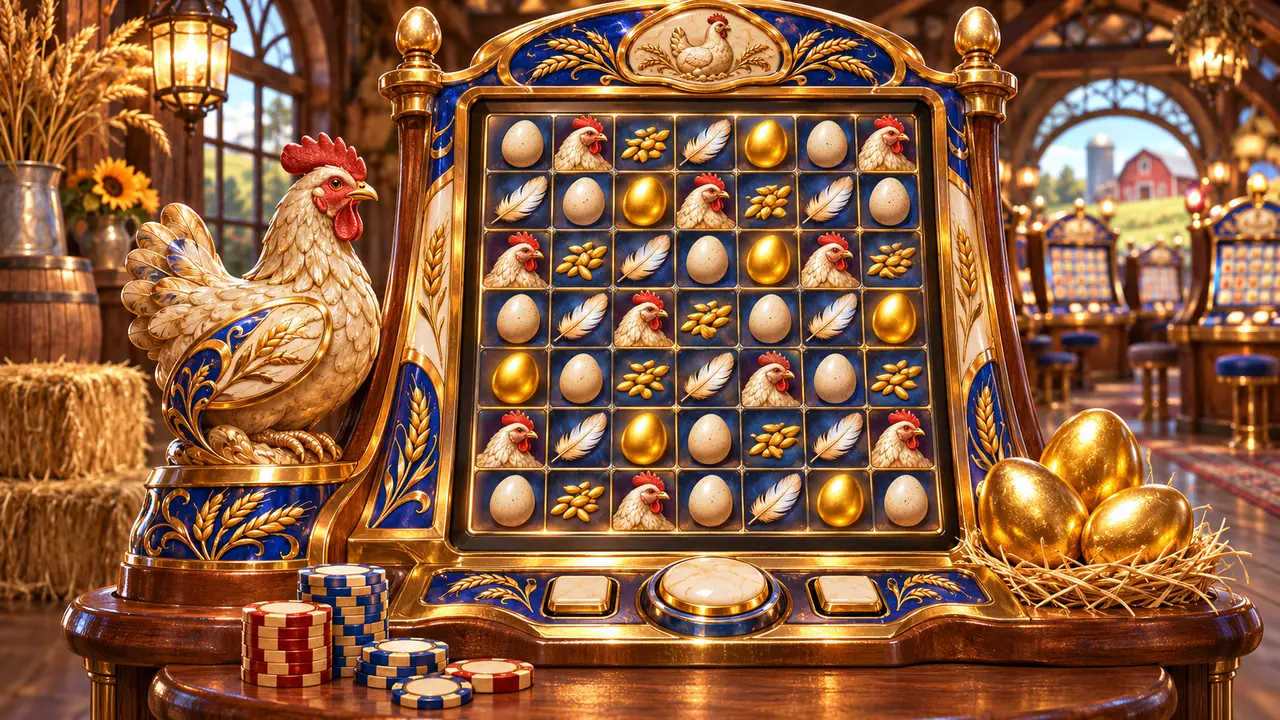
Published facts for Chicken Drop
| Published field | Value and source scope |
|---|---|
| Provider | Pragmatic Play |
| Format | Cluster-pay video slot with tumbles |
| Grid | 7×7 |
| Published operator RTP example | 96.50% · MrQ published listing |
| Release announcement | 2021-07-29 |
Explore the provider demonstration

Load the provider’s demonstration to view the game interface. It uses a separate provider connection and does not confirm any casino account’s game model.
In this guide
- What does the Golden Egg change?
- How do the modifier symbols build the feature?
- Why are tumbles part of the same explanation?
- What changes when free spins begin?
- How should the 96.50% RTP example be interpreted?
- Are an individual symbol prize and the game maximum interchangeable?
- What distinguishes this from Sugar Rush?
- What should be checked before leaving the rules screen?
- Locate the egg’s footprint within the whole board
- Count width and height without inventing intermediate upgrades
- Read coverage and multiplier as separate properties
- Clover and Watering Can names should stay attached to their roles
- Transformation produces an arrangement that must be evaluated
- Check Chicken Drop’s own connection rule
- Keep a tumble sequence in chronological order
- Persistent free-spin upgrades need their feature boundary
- Repeated egg activity does not make every spin identical
- The additional-five instruction is a separate scatter event
- A symbol paytable example cannot define the whole game cap
- A large factor needs an identified underlying award
- Separate return on stakes from survival of an opening balance
- Check the title before following a chicken-themed result
- Say exactly which property changed
- Use the catalogue to continue with a distinct mechanic
- Separate an observed control from a documented feature
What does the Golden Egg change?
An egg changes a region of the grid into matching symbols. It is a symbol transformation, rather than a payment made simply because a large object appears. Whether the changed arrangement pays still depends on the resulting cluster and the game’s evaluation rules.
Size and multiplier must be read separately. A larger transformed region changes which matching symbols can be brought together. A multiplier changes how a qualifying value is treated. Increasing one does not establish that the other increased, and neither tells the player which symbol will appear next.
| Item on the screen | Read it as | Avoid confusing it with |
|---|---|---|
| Egg coverage | Positions being transformed | A guaranteed payable cluster |
| Multiplier | A factor used by its stated rule | The chance of a feature starting |
| Tumble sequence | Continuing evaluation of the changing board | A forecast for the next paid round |
How do the modifier symbols build the feature?
MrQ assigns separate roles to Clover and Watering Can symbols in the egg transformation: Clover affects the multiplier, and Watering Can affects size. Its description gives coverage from two-by-two to six-by-six and multipliers reaching 11x. Read each change with its own display, so the range of sizes does not become confused with the factor used for an award.
Those are two different progress indicators. Watch the egg’s footprint and the multiplier display individually rather than treating a busy tumble as evidence that both improved. A change becomes useful only through the rule to which it belongs, not through the amount of animation surrounding it.
Why are tumbles part of the same explanation?
A qualifying cluster can disappear and make room for replacement symbols. The next arrangement is therefore related to the screen that preceded it, but it is not a prediction about a future separately paid round. This is why following the sequence matters more than counting isolated screenshots.
For a hypothetical example, imagine a qualifying match clearing space, followed by a modifier appearing and an egg covering part of the refreshed grid. Examine the transformed symbols next. Do not assign an invented prize to the egg itself or assume that every transformation creates a payable cluster.
What changes when free spins begin?
The provider’s launch explanation connects the feature to four or more scatter symbols and describes Golden Eggs during the feature. Its product page also distinguishes the repeated egg action from an ordinary base-game tumble. That is a structural difference between the two stages.
MrQ’s description says feature upgrades remain active during free spins and that four or more scatters can add five further spins. Read such instructions as rules for the stated feature, rather than a claim about how often it starts. A persistent upgrade and a frequent trigger are not the same property.
How should the 96.50% RTP example be interpreted?
The operator’s percentage describes theoretical return over the long run. It does not say that 96.50% of spins pay, that a balance falls at a fixed rate or that a bonus arrives within a set number of rounds. A printed return figure cannot supply any of those separate probabilities or tell when a session will recover earlier losses.
To compare records, first keep the stake per paid round separate from the opening balance. Repeatedly staking recycled funds can produce a total staked amount much larger than that opening balance. The return calculation concerns the accumulated stakes and prizes, not a promise to preserve an initial deposit.
Are an individual symbol prize and the game maximum interchangeable?
The launch article discusses a large strawberry cluster as a particular symbol result. That does not make its value the overall cap for every possible feature sequence. A game maximum and an entry in a symbol paytable answer different questions.
This matters when a screenshot is used as evidence. It may show one cluster, several tumble results or a completed feature total. Until the stage and settlement label are clear, comparing the displayed number with a differently labelled result can create a false impression of scale.
What distinguishes this from Sugar Rush?
Both guides concern cluster-based games, yet the important objects differ. Chicken Drop centres on an egg changing symbol coverage. Sugar Rush’s position-based multiplier design requires a different reading of the board. Similar colours and a shared studio do not establish identical bonus rules.
The practical comparison is to identify what persists after each event: symbols, occupied positions, an upgrade or a counter. That question helps a reader follow the specific game. It provides more information than a generic claim that one colourful slot is more generous than another.
An egg’s coverage and the full grid are different areas. Check which positions changed before interpreting the next evaluation; unchanged symbols outside that area may still affect what follows.
What should be checked before leaving the rules screen?
Confirm the exact title, the displayed return and the meaning of each feature counter. Keep demo credits separate from cash records. A demonstration can clarify where an instruction appears, but a short observed sequence cannot establish a personal return rate or an expected feature frequency.
Locate the egg’s footprint within the whole board
The seven-by-seven layout contains forty-nine visible positions. That geometric count describes the board, while the egg’s footprint describes a selected region within it. A two-by-two region contains four positions; a six-by-six region contains thirty-six. These products are simple area counts derived from the published dimensions. They are not payout multipliers, numbers of winning lines or probabilities of a qualifying cluster.
Draw the whole example board before shading the egg’s footprint. The unshaded positions remain part of the arrangement even though the egg leaves them unchanged. Keeping that surrounding space visible helps explain why the transformed region and the board eventually evaluated are different things. The artwork identifies an operation on selected positions; it should not hide the other symbols whose relationships may matter to the next result.
Count width and height without inventing intermediate upgrades
The published operator description gives a range from two-by-two to six-by-six coverage. That establishes the stated endpoints but does not, by itself, specify every intermediate upgrade step or the number of Watering Can events needed to reach one. Do not turn a coverage range into an invented progression table. A table of intermediate requirements would need the exact upgrade instruction from the loaded rules.
Geometry alone can compare coverage: a three-by-three square contains nine positions, and a four-by-four square contains sixteen. Label that drawing as an area illustration. It does not establish that Chicken Drop awards either size after a particular number of modifier events. The actual upgrade schedule still belongs with the loaded rule that defines it, even though the increase in covered space is straightforward to count.
Read coverage and multiplier as separate properties
Egg size identifies which positions are transformed. A multiplier identifies a factor used under its stated award instruction. The two can be displayed together without being the same property. If only the footprint changes, do not report that the factor also increased. If a factor changes, do not redraw a larger region unless the feature actually changes its size.
Give an example note separate entries for coverage and the displayed factor. Under MrQ’s description, a Watering Can event helps explain size and a Clover event helps explain the multiplier. Record the change actually visible or established by the rule. If the second property is not shown to change, leave it unresolved. The sequence is easier to follow when each modifier is connected to its own effect.
Clover and Watering Can names should stay attached to their roles
The operator description assigns distinct roles to these modifier symbols. Preserving the names matters because the reader may need to identify which instruction explains a particular screen change. Replacing both with a generic word such as bonus can conceal whether the question concerns coverage or multiplication. The artwork may be decorative, but the symbol category in the rules is an input to the explanation.
Suppose a worked sequence shows a Clover-related change followed by a Watering Can-related change. Keep the associated display beside each event and describe them in order. Both changes can be explained without calling the result a larger egg worth an invented amount. The eventual symbol selection, group qualification and completed award still need their own evidence, even when the modifier progression itself is clear.
Transformation produces an arrangement that must be evaluated
An egg changes covered symbols into matching symbols, but the changed arrangement still needs the game’s cluster evaluation. A transformation event and a settled award are therefore separate transitions. The feature can alter the inputs to a result without being correctly described as a payment at the instant the egg appears. Wait for the relevant evaluation before naming an award.
A teaching sketch can show the region before transformation, the matching symbols afterwards and the group recognised in the next evaluation. Give each view its own label. Under the actual connection rule, matching symbols outside the footprint may also matter, so the final group need not be identical to the shaded area. If that rule is unavailable, leave membership uncalculated instead of treating the egg’s outline as a complete paytable instruction.
Check Chicken Drop’s own connection rule
The related Sugar Rush article includes a verified horizontal-and-vertical adjacency instruction and a minimum cluster size. Those facts belong to that original game. They do not become Chicken Drop facts merely because both titles use a seven-by-seven cluster format. Where this page has not established a specific connection or minimum rule, check the Chicken Drop help rather than transferring the other title’s numbers.
The common format is still useful for choosing a guide. Both require attention to groups rather than simply counting every matching icon on the screen. Their feature objects differ: transformed symbol coverage here and marked-position values in Sugar Rush. Comparing the known objects clarifies the distinction while leaving an unverified input open. A shared provider is a reason to check exact titles carefully, not a substitute for checking their separate rules.
Keep a tumble sequence in chronological order
A qualifying cluster can be removed, replacement symbols can arrive and a modifier can then become relevant. The order matters because each operation acts on a particular board state. Applying an egg to a sketch of the earlier arrangement after the actual game has already refilled would explain the wrong inputs. Preserve a fresh state after each relevant transition.
For an illustrative sequence, call the original board A, the refill B and the transformed board C. These are note-taking labels, not advertised game stages. An egg acting on B should not be drawn as if it changed the earlier A arrangement. The labels preserve the order without assigning a symbol prize, and keep several views of one continuing round from being counted as unrelated paid starts.
Persistent free-spin upgrades need their feature boundary
MrQ’s description says upgrades remain active during free spins. The supported scope is the stated feature. It should not be expanded into a permanent upgrade attached to the account or every later base-game round. Persistence is meaningful only when the object retained and the period of retention are both identified. Keep the feature name beside the upgrade state.
Record an upgrade already active at the start of a later example free spin, then note any further change that is actually observed. If the source does not establish how that state resets at feature end, keep the question for the loaded help. The supported statement concerns retention during free spins. It supplies no account-wide progression, reset amount or initial entry state beyond what the evidence describes.
Repeated egg activity does not make every spin identical
The provider distinguishes the egg action during free spins from an ordinary base-game tumble. That structural difference explains why the active stage matters. It does not establish that each free spin produces the same transformed symbol, group size or result. Repeated application of a feature can operate on changing arrangements and therefore requires a new evaluation of the relevant state.
Two illustrative free spins can share a retained upgrade while showing different surrounding symbols. Keep both facts in the note. Matching coverage does not imply matching awards, because the egg operates on the board presented at that point in the sequence. Each event still needs its own symbols and qualifying conditions to explain the result. A retained property alone cannot reconstruct all the remaining inputs.
The additional-five instruction is a separate scatter event
The operator description says four or more scatters can add five further spins. This is an addition rule within the stated feature, distinct from the provider’s scatter condition for starting free spins. A starting trigger and a later extension have different roles in a chronological explanation, even where both use scatter symbols as inputs. Name the stage before applying the instruction.
In an example feature log, distinguish the opening scatter event from any later qualifying additional-spin event. A long recording cannot prove that the extra five occurred; check the actual instruction or counter change. Nor does a continuing feature automatically mean another stake was purchased. The documented extension can explain further activity when its condition is established, while any missing trigger or financial entry should remain separately identified.
A symbol paytable example cannot define the whole game cap
The provider launch discusses a particular large strawberry result. That is a claim about a symbol outcome in its stated context. The maximum of a full round or feature would require a separate rule identifying that boundary. One cannot promote a conspicuous symbol example into the universal ceiling merely because no larger result is shown in the same article.
The same distinction applies to a screenshot. A number beside a strawberry cluster may identify one evaluated component. A number in a feature-summary panel may identify a completed total. Their labels and units must match before they can be compared directly. Keep the article’s established symbol scope instead of attaching an unsupported maximum to the game or assuming that a modifier applies to every component visible in an image.
A large factor needs an identified underlying award
The operator’s described multiplier range reaches eleven times. That factor is incomplete as a money calculation until its object and underlying value are known. It does not mean eleven times the account balance, eleven times every visible number or an elevenfold chance of a feature. A multiplier’s scope comes from its instruction, not from the size of its numeral.
For an independent arithmetic illustration, a factor applied to one component before another is added can differ from the same factor applied to the combined total. This is why an explanatory record needs the relevant eligible component and operation. The illustration supplies no Chicken Drop payout formula. Where the loaded rule or result breakdown is absent, the correct conclusion is that the calculation cannot yet be reconstructed from the visible factor alone.
Separate return on stakes from survival of an opening balance
The 96.50% operator example describes theoretical return on stakes over the model. It is not a promise to preserve that fraction of a deposit. Returned funds may be staked again, so total stakes can accumulate beyond the opening funds. A balance photograph records one moment; it does not, by itself, record every amount committed during the intervening rounds.
An example reconciliation can give opening funds, paid stakes and settled returns their own columns. Any observed percentage then describes the recorded events, with its own denominator. A short sample cannot verify the theoretical model or predict when a Clover, Watering Can or scatter appears next. The return figure remains useful configuration information without becoming a repayment schedule or a counter for events supposedly still due.
Check the title before following a chicken-themed result
This article concerns Pragmatic Play’s original cluster slot. A road-crossing game or a cash-out title with a similar name can have different inputs, controls and outcome structure. Read the provider and complete title before treating a search result as evidence. The presence of a chicken graphic does not identify an egg-transformation rule or the 96.50% operator publication.
For a source check, put the game name, provider and mechanic beside each statement you extract. A cash-out instruction from another chicken-themed title will then remain visibly separate from this cluster-board explanation. The check prevents superficially similar results being assembled into a fictional hybrid. It also keeps a demonstration address and its symbols attached to the particular title for which they were recorded.
Say exactly which property changed
Instead of writing that the egg became better, specify whether its footprint changed, its displayed factor changed or a retained upgrade was carried into the next free spin. Those statements answer different questions and can be checked against different parts of the screen. A broad description of improvement obscures the exact rule the reader is trying to understand.
An illustrative caption can identify a Watering Can-related size change and outline the region without assigning a prize. Another can show a Clover-related factor change with no observed alteration to coverage. If the modifier’s arrival is not in the image, describe only the visible resulting state. The distinction makes the picture informative while leaving its unseen cause or completed cash outcome unverified.
Use the catalogue to continue with a distinct mechanic
Choose Sugar Rush when the question concerns position marks and repeated winning removals, and Temple Tumble when it concerns blocked positions being cleared. Choose the cluster-rules guide when the uncertainty is about group membership. These paths are useful because they identify different rule inputs. A colourful grid alone does not tell the reader which article answers the unresolved question.
Before continuing, retain the specific Chicken Drop question in the notes. It might concern the boundary of the egg’s coverage, the role of a modifier or the scope of an upgrade during free spins. A focused question helps prevent the next article’s thresholds or counters from being imported into this title. The purpose of the comparison is to understand separate instructions, with each source and configuration remaining attached to its own game.
Separate an observed control from a documented feature
A demonstration may expose the information button, current grid and feature labels. Those observations can help a reader locate the rules without proving that every feature described in the publication was entered during the observation. Record whether an egg transformation, an upgrade or only the opening screen was actually visible. The launch record and rendering status should retain their existing qualifications.
A mobile observation may show where a readable rules panel or resized board appears on that device. It cannot verify an operator account, pound stake range or successful withdrawal. Keep that context with the image. The guide can use it to explain where the transformation inputs are shown, while leaving cashier and installation questions to records that actually establish those facts for the relevant environment.
Questions and answers
What is the Chicken Drop RTP?
MrQ’s publication gives 96.50%. Read the return in the specific game configuration you open.
Can Chicken Drop activate free spins?
Yes. The provider describes entry from four or more scatter symbols. That trigger rule does not establish how often the feature occurs.
What does the Golden Egg do in Chicken Drop?
It changes the symbols within its footprint into matching symbols. The resulting arrangement still needs evaluation under the game’s rules.
Is Chicken Drop a road-crossing cash-out game?
No. The Pragmatic Play title described here is a seven-by-seven cluster slot with egg transformations.
Can Chicken Drop be played on mobile?
MrQ’s FAQ describes mobile compatibility. Check the version opened for the display and controls actually provided on that device.
Sources and scope
Reviewed 10 November 2026. GB means England, Scotland and Wales. Provider examples do not establish availability on every account.