




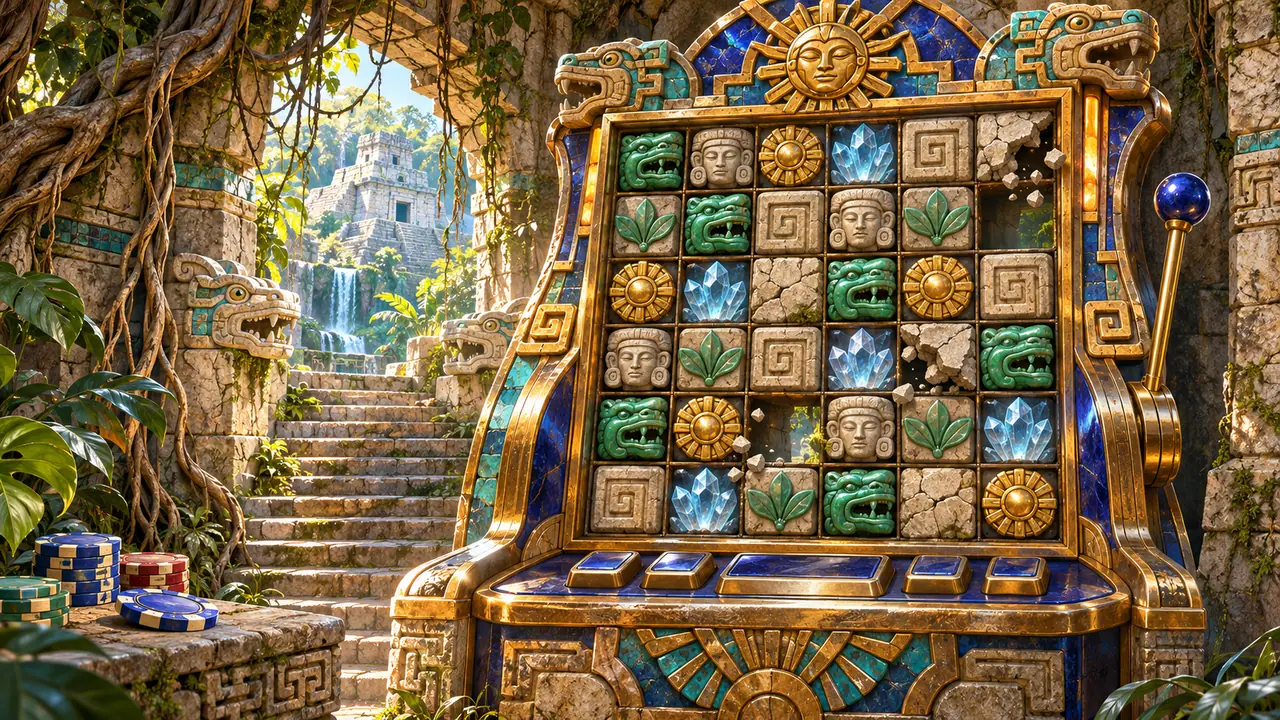
Published facts for Temple Tumble Megaways
| Published field | Value and source scope |
|---|---|
| Provider | Relax Gaming |
| Format | Megaways video slot with cascades and stone blockers |
| Grid | 6×6 |
| Maximum ways | 46,656 |
| Provider volatility label | High |
| Release announcement | 2019-01-29 |
Follow the feature sequence

Explore the theme, then read the game-specific feature explanation below.
Read the Temple Tumble Megaways feature notesIn this guide
- What happens to a winning arrangement?
- Why do the stone blocks matter?
- How should the three bonus choices be compared?
- A board-clearing example without an invented prize
- What does 46,656 ways actually tell you?
- Which RTP and version should be read?
- How does the high-volatility label affect interpretation?
- What changes in a comparison with other games?
- Separate an obstruction from a paying symbol
- Check that every required stone has cleared
- Do not replace the stone condition with a scatter rule
- Distinguish a refill from stone-clearing progress
- The six-by-six description is a board dimension
- Maximum ways does not mean every board has that many wins
- Compare line counts and ways counts through their definitions
- The bonus choices alter different quantities
- Read the opening count from the actual choice screen
- A selected route belongs in the event history
- A UK identifier is not a percentage calculation
- Another territory’s return does not fill the GB field
- Progress already made does not specify the next transition
- The high-volatility label does not identify a trigger schedule
- Close the round with settlement rather than the choice panel
- Compare blockers, transformed regions and stored counters
- Check which stage the screenshot shows
What happens to a winning arrangement?
The original game links a qualifying result to a change in the board. Winning symbols disappear and replacements can fall into the available positions. A further qualifying match belongs to that continuing sequence rather than demonstrating that the next separately paid round must also win.
Tumble names the replacement process on the game board. It does not describe a payment method or another balance. Several changes can occur before one round settles, so a long animation need not mean several paid starts. Read the developing board for the mechanic and the completed game record for the round’s result.
Why do the stone blocks matter?
Stones occupy space that the player needs to distinguish from ordinary paying symbols. Relax’s launch explanation connects their removal with progress towards the feature. The useful question during a round is which spaces changed, not simply how many colourful symbols appeared.
Clearing the relevant stone blocks opens the free-spin stage. That makes the original title’s route different from a game whose feature is explained only by counting scatter icons. Read the actual board’s progress rather than importing a trigger from another slot in the same studio’s catalogue.
How should the three bonus choices be compared?
The studio describes a choice between additional spins, multipliers and a mixture of those benefits. These options change the structure of the feature. A larger displayed multiplier and a longer spin allowance are different quantities, so neither alone establishes which option produces a larger eventual return.
Additional spins create more occasions on which the feature can continue. A multiplier changes a qualifying amount according to its rules. Without the feature’s complete probabilities, counting either item cannot settle an expected-value comparison, and the result of one previous feature is not a substitute for that information.
Read the choices by what they change in the feature. Find the fixed elements, then the spin allowance or factor that each route alters. The size of an illustrated prize and another person’s short session cannot identify the better eventual result. The descriptions can still explain how the routes behave, even while the information needed for an expected-value comparison remains unavailable.
| Published choice | Quantity to identify | What it does not establish |
|---|---|---|
| Extra spins | Number of remaining feature rounds | A guaranteed total prize |
| Multiplier | How the factor applies to a qualifying result | The probability of that result |
| Combination | Which benefits are active together | A personal expected return from one session |
A board-clearing example without an invented prize
Consider a hypothetical paid round that starts with several stones still present. A qualifying match disappears, fresh symbols enter and another useful match changes the board again. If that sequence clears the required stones, the game presents its free-spin choices.
The example stops at the decision point. It does not assign a prize to an unseen arrangement, assume that all cascades pay or claim that a partially cleared board guarantees entry on the following round. Its purpose is to separate the qualifying match, board change and feature trigger.
What does 46,656 ways actually tell you?
The published count describes possible ways of forming a match within the game’s arrangement. It is not the number of prizes won on every screen. Symbol identities, qualifying lengths and available positions still determine whether any particular route counts.
A game can therefore advertise many potential ways while a round produces no qualifying result. Comparing that number directly with another game’s fixed paylines misses the rules attached to both. The count explains the evaluation format; it cannot rank two games’ next spins.
Which RTP and version should be read?
Relax’s current product page identifies an alternative UK game version separately from its other listed variants. The identifier itself does not prove a numeric return, and a published return for a different territory should not be moved into a GB fact table.
Read the return shown in the opened game information together with the exact title. That prevents a provider-wide average, an older review or a similarly named sequel from becoming an assumed setting. The value describes that configuration’s long-run model, not a repayment schedule for a session.
How does the high-volatility label affect interpretation?
The original release describes Temple Tumble as highly volatile. Treat that as a statement about variation in its prize pattern. Several quiet rounds and a visually dramatic feature can coexist without either event revealing whether the next round is favourable.
Session length also changes total exposure. Reusing a balance for more paid rounds increases the amount staked across the session even when the visible starting balance is unchanged. Feature choices and cascading animations do not remove that arithmetic.
What changes in a comparison with other games?
Chicken Drop is another cascading design, but its Golden Egg changes symbol coverage. Hand of Anubis uses a different cluster structure. Reading those specific feature rules makes the contrast useful without turning the number of ways, the number of cells or a striking animation into a recommendation.
Separate an obstruction from a paying symbol
A stone block occupies space but has a different role from an ordinary symbol evaluated for a match. Counting every object in the window as a potential paying symbol would obscure the board-clearing feature. Begin by identifying which positions are blocked and which contain symbols currently available to the ordinary evaluation. The two categories describe different inputs to the round.
In a teaching drawing, shade the stones and use letters for ordinary symbols. After a documented clearing event, update the affected positions; if symbols change elsewhere, leave the stone count alone. The contrast shows what progressed without assigning a prize. It also stops a colourful refill from doing more work in the explanation than the rules support: movement and removal of an obstruction are not automatically the same event.
Check that every required stone has cleared
The original launch description connects free-spin entry with clearing all stone blocks on the screen. The word all gives the condition its boundary. Removing some stones is progress towards that condition, while leaving any required stone present does not establish completion. A partially clear board should therefore be described as a state in the sequence rather than as an already-triggered feature.
Start a worked example with several marked stones, then remove only those the qualifying event is shown to clear. Check the remaining required blocks. If one is left, the completion condition remains unmet; if none remain under the stated rule, the choice stage becomes relevant. This checks a current condition. It leaves the chance of another clearing event, and any wait for it, unknown.
Do not replace the stone condition with a scatter rule
Many slot descriptions use scatter counts to explain free-spin entry, but that familiarity is not evidence for this title. Temple Tumble’s documented route here is stone clearing. A guide that inserts a remembered three-scatter rule would change the input rather than clarify it. The useful observation is which obstruction positions changed and whether the clearing condition is complete.
Compare the trigger wording with that of a scatter-based game. One checks a specified special-symbol event; Temple Tumble checks the required blocked positions. Both may open free spins, yet they need different evidence to establish entry. The feature name cannot supply the missing trigger rule. Identify what this title counts or clears before carrying over a familiar symbol count from another article.
Distinguish a refill from stone-clearing progress
A tumble can replace symbols after a qualifying result. A stone-removal instruction concerns the blocked positions affected under its own rule. These events may interact, but the mere fact that new symbols arrived does not prove that every stone changed. Read the obstruction state independently from the ordinary-symbol arrangement after each relevant transition.
A useful round note separates the recognised match, the board update and the blocked positions still remaining. That gives each change a place in the account. A replacement need not be another paid spin, and a refill need not clear a stone. With those entries kept apart, the reader can see which observed event affected the condition for opening the feature.
The six-by-six description is a board dimension
The published six-by-six layout describes the space in which the game operates. Multiplying those dimensions counts thirty-six positions in the geometric rectangle. That number is different from the maximum ways count, a stone count or a count of simultaneous awards. A board can contain different kinds of positions, so its dimensions alone do not establish the currently available qualifying routes.
Draw the full example rectangle, then mark blocked and available positions as separate layers. The outline explains the nominal layout, while the layers show why the actual arrangement still matters. The evaluation rules determine which positions count towards a result. Thirty-six cells on a diagram do not become thirty-six feature entitlements or separate prizes; they simply locate the spaces whose roles need to be checked.
Maximum ways does not mean every board has that many wins
The 46,656 figure is presented as a maximum ways count. Maximum and ways both matter to its meaning. The first identifies an upper format boundary; the second concerns potential matching routes under the evaluation structure. Neither word says that the game awards 46,656 prizes whenever the reels stop. The actual symbols and qualifying conditions still have to be checked.
An abstract ways illustration can use different numbers of eligible positions on successive reels and multiply those counts to describe possible combinations. That exercise explains why a ways format differs from following one predefined line. It does not specify Temple Tumble’s complete calculation for a particular board, because the relevant eligible positions and restrictions would still be needed. A catalogue maximum cannot supply every board-specific input.
Compare line counts and ways counts through their definitions
A fixed-line count identifies a set of permitted paths, while a ways count describes another evaluation structure. Ranking games by whichever count is numerically larger ignores those definitions. Twenty-five lines and thousands of ways are not measurements of the same personal probability or expected profit. The rules attached to each count determine the useful comparison.
For a hypothetical guide choice, use 1429 Uncharted Seas to understand following a line through five reels and Temple Tumble to examine the ways-and-blocker arrangement described here. Keep symbol qualification and award values within each game’s own help. The comparison can explain how results are recognised without claiming that the larger advertised count makes a particular next round more favourable.
The bonus choices alter different quantities
The provider describes additional spins, multipliers and a mixture. A spin count is an entitlement to events under the feature’s rules. A multiplier is an operation applied to an eligible value. They cannot be added into a meaningful score merely because both look advantageous in the choice panel. Start by naming which quantity each option changes.
Use separate fields for the opening spin opportunities and the factor behaviour described by each option. Fill them from the actual choice wording, leaving unsupported values open. A route with more spins may also have a different multiplier structure. Without the probabilities and full award interactions, the fields cannot produce an expected-return ranking. They can, however, make the documented mechanical differences easier to compare.
Read the opening count from the actual choice screen
The saved provider evidence supports the categories of the three choices without establishing a fixed initial free-spin count for this GB guide. A neat option table populated with remembered counts would therefore overstate the evidence. Keep the category description and consult the loaded help for the exact numeric entitlement in the version being viewed.
A worked explanation can pause at the choice screen and ask what spin count and factor the loaded version displays. It does not need to supply a guessed answer. The distinction between extra spins and a multiplier is still clear when an entitlement remains unknown. Keep that gap visible instead of borrowing a count from the artwork or a familiar bonus menu in another title.
A selected route belongs in the event history
Once a feature choice is made, later activity needs to be interpreted under that route’s rules. Two records can share the same clearing trigger yet show different counter or multiplier behaviour because their choices differed. Omitting the decision can make those records appear contradictory when they are actually descriptions of separate branches.
Record the completed clearing condition, the option selected and the initial state shown afterwards. Keep subsequent events attached to that route. If the choice label is missing from the image, leave the route unidentified until another record establishes it. The final award is not enough to work backwards to a unique choice, even when two recordings look similar at their endpoints.
A UK identifier is not a percentage calculation
The current product material identifies a separate UK game version. An identifier is a label for a build or configuration, not a formula giving its theoretical return. Digits in a game identifier cannot be converted into a verified percentage without an explicit statement establishing that meaning. The source’s country-specific distinction should remain visible without a guessed numeric RTP.
Check what the public demonstration actually identifies. It may show the title and mode without proving that an operator has selected the GB build. Keep its launch context and recorded verification status. Where the loaded rules are available, they give more direct evidence about the observed configuration than a URL suffix does. A general product page cannot settle every question about that particular installation.
Another territory’s return does not fill the GB field
A provider can publish different variants for different territories. A return explicitly associated with another territory answers that variant’s question; it does not automatically identify the UK version. Moving it into a GB fact table would erase its scope. This page leaves the unverified numeric UK return open rather than making the table appear complete through substitution.
Keep title, territory or build, displayed RTP and source in separate comparison fields. An unavailable value can stay blank with a short explanation. That is more useful than averaging unrelated percentages or treating a general provider figure as a confirmed local setting. The missing return field does not stop the guide explaining how the stones are cleared or how the feature choices differ.
Progress already made does not specify the next transition
A nearly cleared board has a defined visible state, but the remaining obstruction does not come with a published waiting time in this guide. The fact that only one required block remains cannot establish that the next event clears it. Progress and probability are separate questions, even when the interface makes the goal easy to see.
An illustrative caption can say that one required stone remains and that feature entry has not yet been established. It should not say the feature is due, guaranteed or only one paid spin away. The source supplies a condition for entry, not a countdown to the next successful clearing event. Retaining that difference keeps the explanation focused on reading the board rather than forecasting its unresolved arrangement.
The high-volatility label does not identify a trigger schedule
Relax’s original release calls the title highly volatile. That classification does not provide an interval between cleared boards or a number of rounds before a chosen bonus route appears. A short quiet record and a dramatic recorded feature can both be observations without either becoming a schedule for the model. Their event counts remain specific to those records.
When describing a personal observation, distinguish total stakes, final settled returns and feature notes. Reusing returned funds can increase total stakes without increasing the opening balance. Cascades and choices explain activity inside the game, but they do not remove that accounting distinction. A theoretical return, where verified for an installation, would still be a different description from the results of a limited session.
Close the round with settlement rather than the choice panel
The choice panel identifies a branch and may show a spin allowance or modifier. It is not the completed credited result of that branch. A record ending there can explain the decision point but cannot state the eventual feature award. Likewise, a final screen without the opening history can establish a result while leaving the route that produced it uncertain.
To reconstruct a completed sequence, link the clearing event to the selection, the observed feature stages and the settlement. If a link is absent, name it instead of filling it with an assumed value. Do not add intermediate multipliers or repeated totals to the final credit again. The game’s internal explanation and the money record should refer to the same event without turning every displayed numeral into another payment.
Compare blockers, transformed regions and stored counters
Chicken Drop changes a covered symbol region with an egg. Hand of Anubis presents orb-related counters and different feature routes. Temple Tumble asks the reader to identify blocked positions and a clearing condition. These distinctions remain meaningful even when the illustrations share bright symbols and repeated refills. They identify what must be observed to explain a state change.
Before opening another guide, write the unresolved question as an object and an event: which stone disappeared, which region transformed or which counter changed. That wording points to a specific rule rather than a broad impression of progress. Retain the exact game and configuration context beside the note, so the next article’s trigger or persistence details do not silently replace the separate rules established for this original title.
Check which stage the screenshot shows
A stone-free screenshot can establish a visible board condition if the whole relevant area is shown. It does not necessarily show the choice subsequently made, every feature event or the final credited result. Those are later questions. A screenshot with stones still visible can establish the opposite limitation: the displayed state alone does not prove completion of the all-stones condition. Read the condition actually represented instead of allowing a caption about free spins to supply unseen events.
Give the blocked board, cleared board, choice panel and completed feature result their own captions in an illustrated explanation. That lets the reader follow the condition, branch and outcome in order. If only some views are available, use those and identify the missing stages. A partial visual record can explain what it shows without being presented as a complete test of the game.
Update the claim an observation actually establishes. A visible choice screen may confirm its labels in that environment while leaving UK RTP and the GBP stake range unknown. A completed feature may establish that particular sequence while saying nothing about how often it occurs. Keeping those conclusions narrow prevents a successful observation of one part of the game from appearing to verify every specification in the guide.
For example, a choice-panel observation can answer which options were displayed at that moment. It cannot tell how frequently a stone-clearing trigger occurs. Those claims need different evidence, so retain the observed option labels without attaching an invented trigger frequency or converting the visible choices into a personal return estimate.
Questions and answers
How many ways does Temple Tumble Megaways have?
Relax Gaming publishes a maximum of 46,656 ways for the original six-by-six game.
What triggers the Temple Tumble free-spin feature?
The original provider release links feature entry to clearing the stone blocks. Follow that condition rather than borrowing a scatter trigger from another game.
What are the Temple Tumble bonus choices?
The launch description offers extra spins, multipliers or a mixture of the two. Read the loaded version for the precise entitlement attached to each choice.
Is Temple Tumble the same as Temple Tumble 2 Dream Drop?
No. This article covers the original Temple Tumble. The later Dream Drop game is a separate release with its own feature design.
Sources and scope
Reviewed 10 November 2026. GB means England, Scotland and Wales. Provider examples do not establish availability on every account.